
Blog
How a Bonded Title Trailer Appraisal Sets Your DMV Surety Bond Amount
A bonded title trailer appraisal establishes the value your state DMV uses to calculate your surety bond, and getting that number wrong can leave you over-bonded or under-protected. Here's how the math works, state by state, and what the process actually looks like.
If you bought a utility, cargo, livestock, or homemade trailer without a title (at an auction, from a private seller who never had paperwork, or from a relative who's long gone), you're not stuck. Every state has a bonded title process that lets you establish legal ownership without the original title. The catch is that the whole process runs on a single number: the appraised value of the trailer. That value sets your bond amount, and the bond amount is your financial exposure if someone with a legitimate prior claim ever shows up.
This guide walks through why the DMV requires a bond in the first place, how the bond math actually works in states like Texas and California, and what the step-by-step process looks like for an individual trailer owner. We'll also flag where states diverge sharply on requirements, because "bonded title" does not mean the same paperwork in every state.
Why the DMV Requires a Surety Bond for a Trailer With No Title
A state won't issue a clean title to a trailer with no ownership history because it has no way to confirm you're the rightful owner. Maybe the trailer was stolen. Maybe there's a lender who still holds a lien on it from a previous owner. The DMV doesn't investigate that for you; instead, it shifts the risk onto you in the form of a surety bond.
A bonded title is a conditional title that lets you register and use the trailer while putting the public on notice that ownership is still, technically, unproven. If someone comes forward within the bond period with a valid prior claim, the surety bond pays out to cover their loss, up to the bond amount. If nobody comes forward, the bond expires and you get a clean, unencumbered title.
That structure is why the bond can't be a flat fee. It has to be tied to what the trailer is actually worth, because the bond exists to make a wronged party whole, not to punish or under-protect the new owner.
How a Bonded Title Trailer Appraisal Sets the Bond Amount
The direct answer: your state DMV calculates your bond as a multiple of the trailer's appraised value, so the appraisal is the single input that determines how much the bond costs and how much liability you're carrying. States use their own multipliers and some set a statutory minimum regardless of what a cheap trailer is actually worth.
A trailer appraisal for bonded title purposes has to be defensible, meaning it can hold up if the DMV, a surety company, or a claimant later questions the number. That's different from a rough estimate or a guess based on a classified ad. An appraisal prepared in accordance with USPAP (the Uniform Standards of Professional Appraisal Practice) documents the trailer's condition, specifications, comparable sales, and the appraiser's reasoning, so the value isn't just a number pulled out of thin air.
Watch out: If your appraised value comes in too high, you'll pay more for the bond premium and, more importantly, you're on the hook for a larger liability figure for the life of the bond. If it comes in too low and the DMV rejects it as unsupported, you'll be sent back to start the appraisal over, which costs you time.
State Bond Calculation Examples
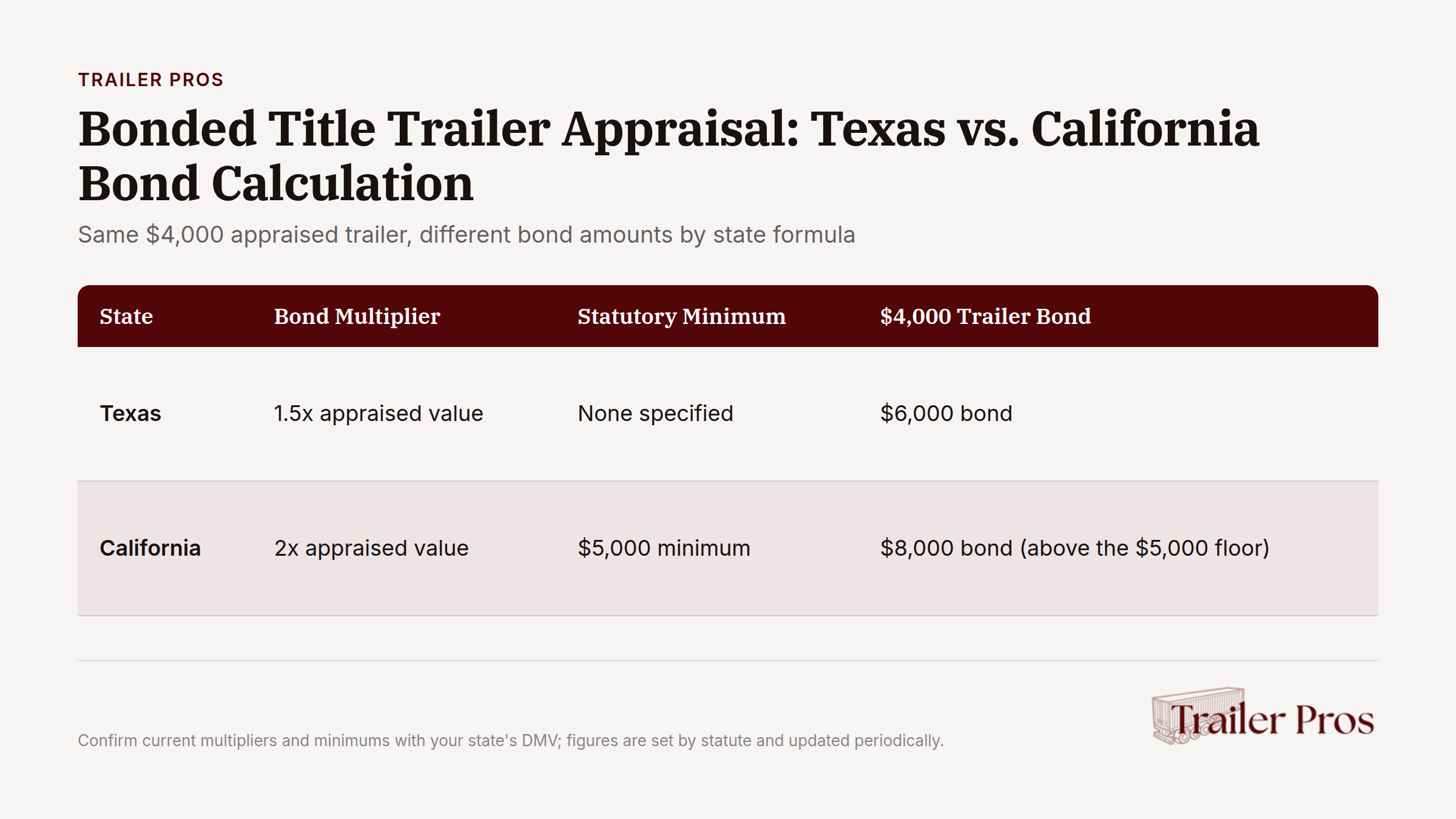
Bond multipliers vary by state, and a couple of examples show how differently the math can land on the exact same trailer.
| State | Bond Multiplier | Statutory Minimum | Example: $4,000 Trailer |
|---|---|---|---|
| Texas | 1.5x appraised value | None specified | $6,000 bond |
| California | 2x appraised value | $5,000 minimum | $8,000 bond (still above the $5,000 floor) |
In California, the multiplier and minimum work together: even a trailer appraised at $1,500 would still require a bond of at least $5,000 under the statutory floor, not $3,000. That minimum exists specifically so low-value vehicles don't slip through with token bond coverage. Always confirm the current multiplier and minimum with your specific state's DMV before you commit to an appraisal or a bond purchase, since these figures are set by state statute and get updated periodically.
Step-by-Step: Getting a Bonded Title for a Trailer
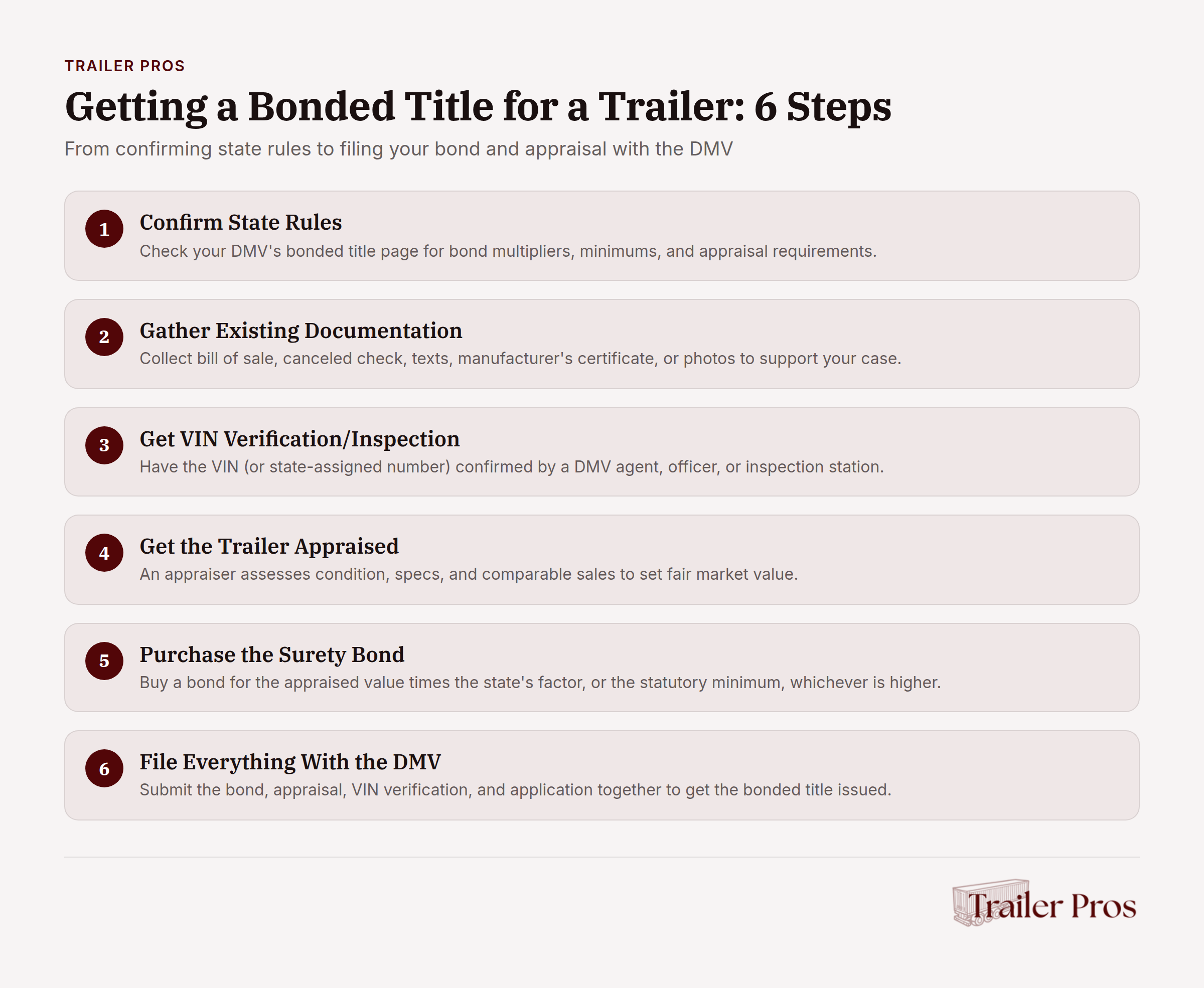
The bonded title process follows roughly the same sequence in every state, even though the specific documentation and appraisal requirements shift from state to state.
- Confirm Your State's Specific Rules
- Bond multipliers, minimums, in-person appraisal requirements, and whether a second appraisal is needed all vary. Start with your state DMV's bonded title or surety bond title page before you spend money on anything else.
- Gather Whatever Documentation Already Exists
- A bill of sale, a canceled check, a text message thread with the seller, a manufacturer's certificate, or even photos of the trailer at the time of purchase all help. None of these alone proves ownership, but together they support your case and give the appraiser useful background.
- Get a VIN Verification or Trailer Inspection
- Most states require confirmation of the trailer's VIN (or a state-assigned number if the VIN plate is missing or a homemade trailer never had one). This is usually a separate step from the appraisal and is often done by a DMV agent, law enforcement officer, or licensed inspection station.
- Get the Trailer Appraised
- A qualified appraiser inspects the trailer, documents its condition, specifications, and any modifications, and researches comparable sales to determine fair market value. This is the number your bond will be calculated from.
- Purchase the Surety Bond
- Once you have the appraised value, you buy a bond from a surety company for the amount your state requires (the appraised value multiplied by the state's factor, or the statutory minimum, whichever is higher).
- File Everything With the DMV
- You submit the bond, the appraisal, the VIN verification, any supporting documentation, and the state's bonded title application together. Processing times vary, but this is typically when a bonded title is actually issued.
Requirements Vary a Lot by State: What to Check Before You Start
The biggest mistake trailer owners make is assuming their neighbor's bonded title experience in another state applies to them. It usually doesn't.
Some states require an in-person, in-state appraisal. Texas and Alaska are two notable examples where the appraisal generally has to be performed in person by a locally qualified appraiser, rather than through remote photo documentation. Because of state-specific licensing and dealer requirements, We are not able to fulfill vehicle title bond appraisals in Alaska, Texas, Colorado, or Delaware. If you're titling a trailer in one of those four states, work with a locally licensed appraiser or dealer who meets that state's specific requirements for title bond work.
Some states require two separate appraisals. North Carolina is a notable example, where the bonded title process typically calls for two independent appraisals rather than one, which the DMV then reconciles.
Some states set a statutory minimum bond regardless of appraised value. California's $5,000 floor under California Vehicle Code 4157.2 means a very low-value trailer still carries a meaningful bond cost. Other states may have no floor at all, so the appraisal does all the work of setting the number.
Pro tip: Call your state DMV's title services line before you schedule an appraisal. Ask specifically whether an in-person appraisal is required, whether a second appraisal is needed, and what the current bond multiplier and minimum are. A five-minute phone call can save you from ordering the wrong type of appraisal.
Why the Appraised Value Matters So Much to You, Not Just the DMV
It's easy to think of the appraisal as a bureaucratic hoop, a box the DMV needs checked. In reality, the appraised value is the number that determines your personal financial exposure for the entire bond period.
Here's the mechanism: the bond amount is the maximum a legitimate prior owner or lienholder could recover from the surety company if they successfully make a claim against your bonded title. If your trailer was appraised at $10,000 when it's genuinely worth $4,000, you may have paid for a bond, and carried liability, well beyond what the trailer justifies. If it was appraised at $2,000 when it's genuinely worth $6,000, you're technically under-bonded, which can expose you if a real claim surfaces and the bond doesn't cover the full loss (some states allow the claimant to pursue the difference directly from you).
Key takeaway: An accurate, well-documented appraisal isn't just a formality for the DMV. It's the number that protects you from being over-bonded on a trailer you already own outright, and it's your best defense if a dispute ever reaches a claim.
A trailer appraisal that's prepared in accordance with USPAP documents the trailer's year, make, VIN or assigned number, axle configuration, condition, modifications, and the comparable sales used to arrive at value. That paper trail matters if the surety company or DMV ever questions the figure, and it matters even more if a claim is actually filed against the bond down the line.
How Long Does a Bonded Title Last Before It's Clean?
Most states hold a bonded title for around three years before issuing a clean, unencumbered title, assuming no one files a valid ownership or lien claim during that window. Some states use a shorter period, so check your state's specific timeline. During the bond period, you generally can register, insure, and use the trailer normally; the bond exists in the background as protection, not as a restriction on daily use.
Once the bond period expires without a claim, you typically file a simple application with the DMV to convert the bonded title into a standard, clean title. At that point, the surety bond can usually be released or allowed to lapse.
Getting the Appraisal Right the First Time
Our trailer title bond appraisal service is built specifically around this process: documenting a trailer's condition and market value in a way that state DMVs and surety companies recognize as defensible, whether it's a livestock trailer, a homemade flatbed, or a standard cargo trailer with no paperwork at all. Fees are quoted as a fixed price after we understand the trailer type and your state's specific requirements; you can see how our trailer appraisal pricing is structured before you commit to anything.
If you're in Alaska, Texas, Colorado, or Delaware, we won't be able to complete a vehicle title bond appraisal for you directly due to state-specific licensing rules, so plan on working with a locally licensed appraiser or dealer instead. Everywhere else, starting a bonded title trailer appraisal request is the fastest way to get an accurate number before you buy your surety bond, so you're not paying for more liability coverage than the trailer actually needs.
This article is provided for general informational purposes only and does not constitute legal, tax, or financial advice. Bonded title requirements, bond multipliers, and statutory minimums vary by state and change over time. Readers should confirm current requirements with their state DMV and consult a qualified attorney regarding their specific circumstances.