
Blog
Why a Bonded Title Trailer Can Cost You Thousands More if It's Stolen
A bonded title trailer carries a hidden financial exposure most owners never see coming: if a stolen-trailer claim is ever paid against your surety bond, you owe the full bond amount back to the surety, not just the appraisal fee you paid upfront.
What a Bonded Title Trailer Actually Is
A bonded title becomes necessary when a trailer owner cannot produce a clear paper title, often because the title was lost, never transferred at a private sale, or simply never existed for an older or homemade trailer. States allow the owner to get a title issued anyway, but only if a surety bond backs it up in case someone else later comes forward with a valid ownership or lien claim. If you want the mechanics of how that process runs from application to issued title, our bonded title appraisal guide covers it step by step. This post covers something different: what happens to your wallet if a claim is ever actually paid against that bond.
Most owners treat the bonded title process as a paperwork hurdle. It isn't. It's a financial guarantee with your name on it, and the number that drives it, the appraised value of the trailer, determines exactly how much you're on the hook for.
How Texas Calculates Your Bond Amount from the Trailer's Value
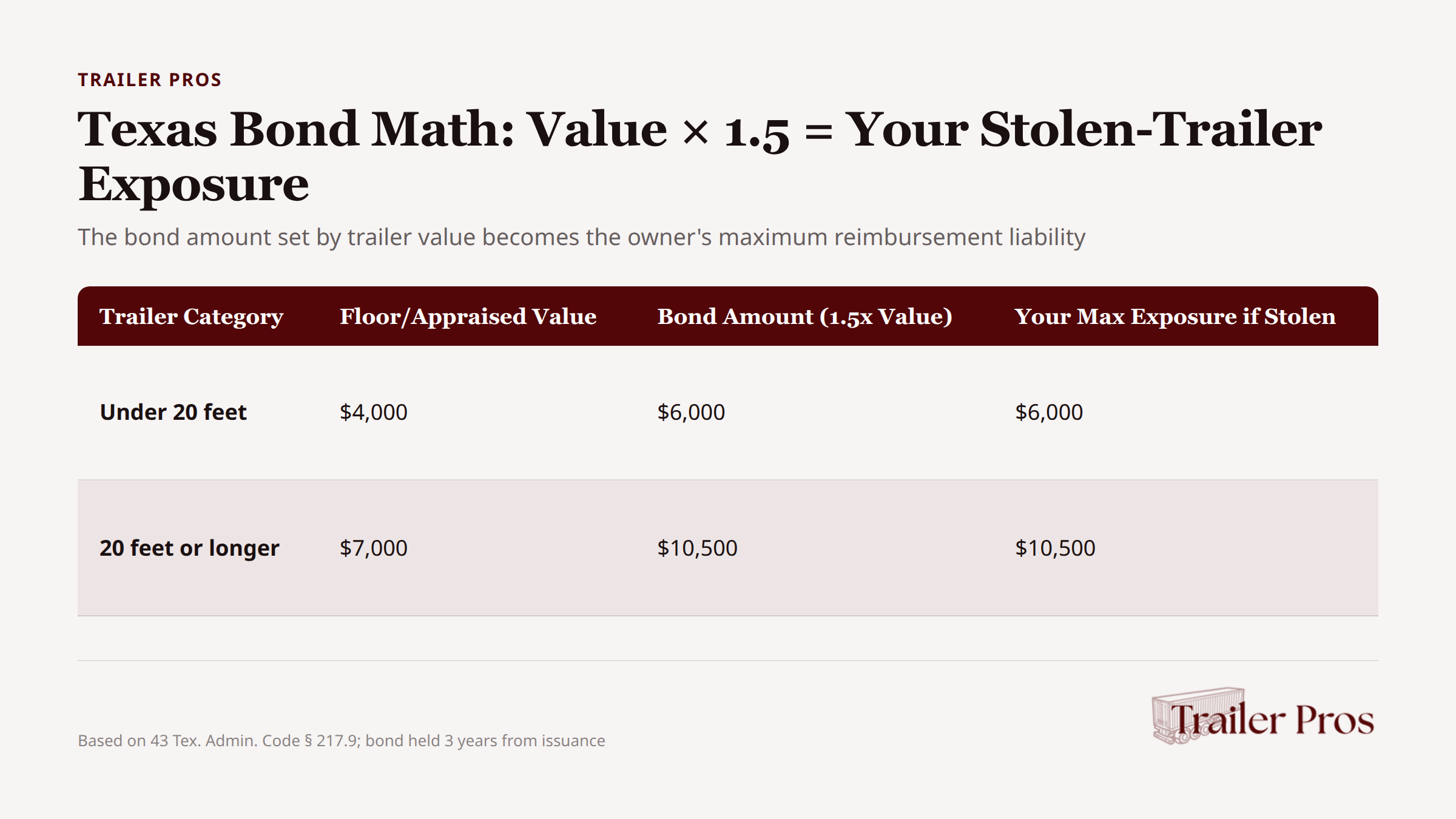
The bond amount for a Texas trailer title bond is set at 1.5 times the trailer's value, and that value comes from either a qualified appraisal or a length-based floor set by the state, whichever applies. 43 Tex. Admin. Code Section 217.9 sets those floors at $4,000 for trailers under 20 feet and $7,000 for trailers 20 feet or longer, before the 1.5x multiplier is applied. The bond then stays in effect for 3 years from the date it's issued, and it follows the trailer even if you sell it to someone else during that window.
Other states use similar formulas with different multipliers. Michigan, for example, requires a bond equal to 2 times the determined value of the vehicle or trailer, also held for 3 years. The mechanism is the same everywhere: the higher the value, the higher the bond, and the higher your exposure.
What "Liability" Actually Means When You're the Bond Principal
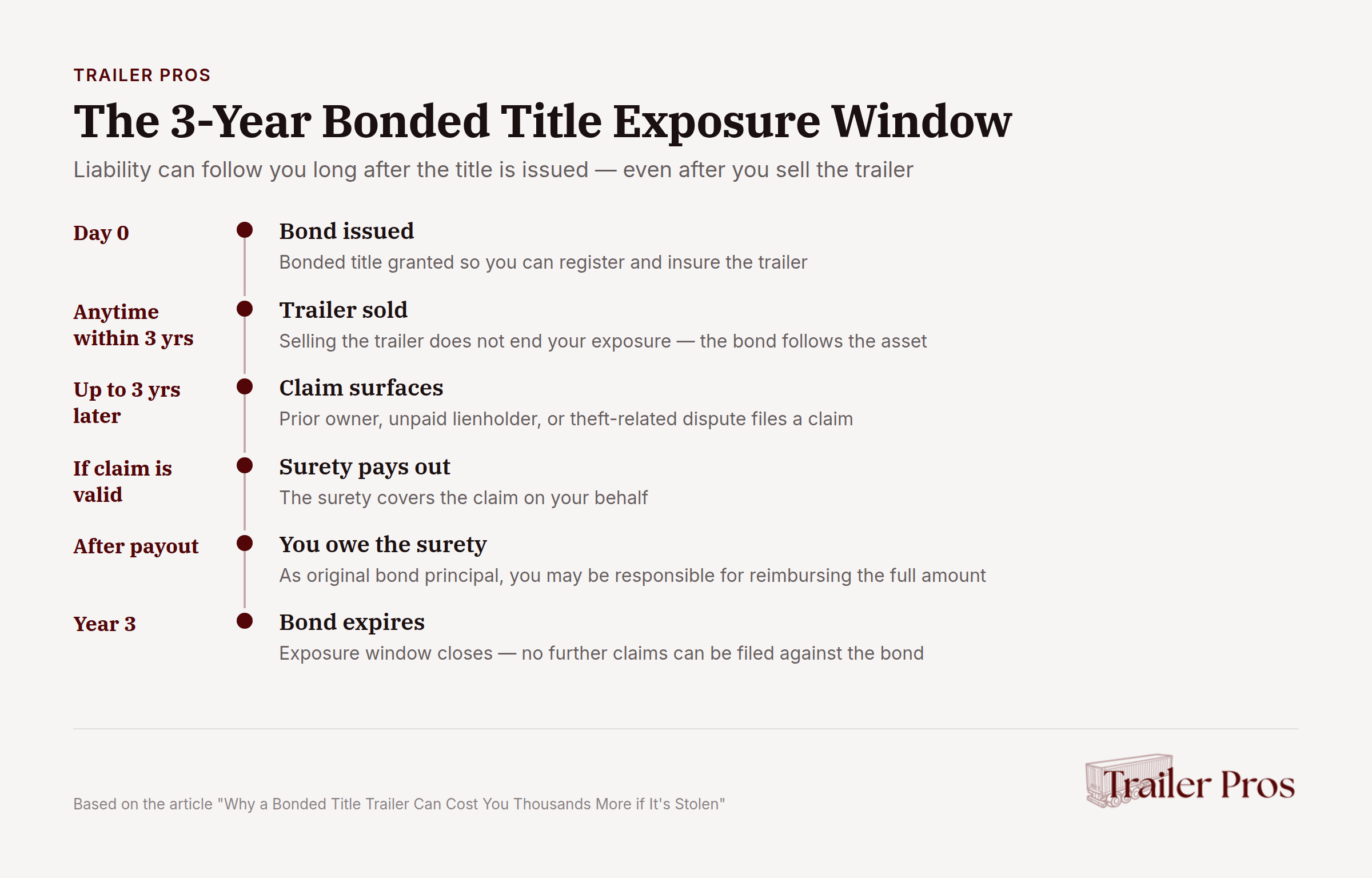
Here's the part that trips up most owners: the bond is not insurance for you, the trailer owner. You are the "principal" on the bond, and the surety company that issues it is extending you credit, not protection. If a claim is filed and paid, the surety pays the claimant first and then comes after you, the principal, to reimburse every dollar it paid out, up to the full bond amount.
That structure is standard across the surety bond industry, not unique to Texas. A title bond functions as a guarantee that the surety backs financially, with the expectation that the bonded party repays any claim amount paid on their behalf. The premium you pay upfront, typically a small percentage of the total bond amount, only buys the right to have the bond issued. It doesn't cap your reimbursement obligation. That's exactly why the Texas owner in the story above was surprised twice: once by the $6,000 bonded valuation, and again when he understood that number represented what he personally owed if a claim landed, not what he'd paid to get the title.
Appraised Value vs. Bond Amount vs. Your Exposure
The table below shows how the 1.5x multiplier plays out at three common appraised-value points for Texas trailers.
| Appraised Trailer Value | Bond Multiplier | Bond Amount | Your Maximum Reimbursement Exposure |
|---|---|---|---|
| $4,000 (Texas floor, under 20 ft) | 1.5x | $6,000 | $6,000 |
| $6,000 (mid-size trailer, 20 ft+) | 1.5x | $9,000 | $9,000 |
| $7,000 (Texas floor, 20 ft or longer) | 1.5x | $10,500 | $10,500 |
Compare that to a standard title transaction, where the only extra cost tied to value is sales tax. With a bonded title, the appraised value doesn't just affect what you pay the state; it sets the size of the financial exposure you personally carry for the next 3 years.
The Three-Year Exposure Window
The bond doesn't expire the day you get your title. It stays active for 3 years, and during that window, a prior owner, a lienholder who was never paid off, or a party disputing the trailer's ownership history (including in a theft scenario) can file a claim against it. If the claim is valid and the surety pays it, you're the one who owes that money back.
This window matters even if you sell the trailer. The bond follows the asset, not just the original owner, so a dispute that surfaces two years after you sold a bonded-title trailer can still trace back to you as the original bond principal, depending on how the claim is structured and who the surety identifies as responsible. That's a meaningfully longer tail of risk than most owners expect when they're just trying to get a title issued so they can register and insure a trailer they already own.
Why the Appraisal Number Matters More than You Think
Because the bond amount is a direct multiple of the appraised value, the number an appraiser puts on your trailer isn't just a formality. It's the exact figure that determines how much you're financially exposed to for the next 3 years. An inflated appraisal pushes your bond, and your reimbursement liability, higher than it needs to be. A lowballed appraisal might get flagged or rejected by the state, delaying your title and leaving the trailer unregistered in the meantime.
This is where a defensible, USPAP-compliant appraisal actually protects you in two directions. It satisfies the state's documentation requirement so your bonded title gets issued without a fight, and it keeps your bond, and your personal exposure, anchored to a realistic number instead of a figure a generic online valuation tool might spit out without ever seeing the trailer.
Watch out: Texas requires an in-person appraisal for vehicle and trailer title bond purposes. This trips people up regularly, since online or remote valuations are common and perfectly acceptable for insurance or estate purposes. For a bonded title specifically, the appraiser has to physically inspect the trailer.
Getting an Accurate, in-Person Appraisal Protects You Twice
Our trailer appraisal for bonded title service is built around exactly this requirement: an in-person, USPAP-compliant inspection that documents the trailer's actual condition, features, and comparable market value, so the number that drives your bond amount reflects what the trailer is really worth. Standard trailer appraisals with us start at $195, with fees quoted as a fixed price after we understand the trailer and the intended use, never billed hourly.
Key takeaway: The premium you pay for a title bond is cheap by design. The exposure behind it isn't. Before you request a bonded title, get an appraised value you can defend, because that number is the ceiling on what you personally owe if a claim is ever paid against your bond.
If you're navigating a lost title, a private-sale purchase with no paperwork, or a DMV request for a bonded valuation, request a trailer appraisal with our team and we'll walk you through exactly what the state needs and what your resulting bond exposure will look like.
This article is provided for general informational purposes only and does not constitute legal, tax, or financial advice. Readers should consult a qualified attorney regarding their specific bonded title or surety bond circumstances.