
Blog
RV vs Trailer: What Sets Motorized and Towable Campers Apart
RV vs trailer comes down to more than towing: motorhomes and towable trailers differ in titling, maintenance, and total cost of ownership in ways that shape your budget for years. This guide breaks down the classes, the costs, and what each option actually fits.
What Actually Separates an RV from a Trailer?
The core difference is simple: a motorized RV has its own engine and chassis, while a trailer has neither and depends entirely on a separate tow vehicle. A motorhome combines the vehicle and the living space into one unit you drive like a truck or bus. A trailer is towed behind a truck or SUV using a ball hitch or a bed-mounted hitch, and it goes nowhere without that tow vehicle attached.
That distinction ripples into almost every other decision in this comparison. It changes how each is titled and registered, what kind of insurance applies, how much you'll spend on fuel and maintenance, and even how each is treated for financing, estate settlement, or a trailer appraisal versus an RV appraisal. Before comparing costs or classifications, it helps to understand exactly what you're choosing between.
Motorhome Classes: A, B, and C
Motorized RVs fall into 3 widely recognized classes, and the class is defined mainly by the chassis underneath the living quarters, according to Progressive's RV guide.
- Class A motorhome: Built on a bus or commercial truck chassis. These are typically the largest and most amenity-rich option, with a flat front, multiple slide-outs, and large fuel and water tanks. Class A rigs are common for extended travel, snowbirding, and full-time living.
- Class B motorhome (camper van): Built on a standard van chassis, often with a raised roof for headroom. Class B units are compact and easy to drive and park, which makes them popular with solo travelers and couples who prioritize maneuverability over floor space.
- Class C motorhome: Built on a cutaway van or truck chassis, identifiable by the cab-over sleeping area above the driver's cab. Class C is the middle ground: more space than a Class B, easier to drive than a Class A, and a common choice for families.
Towable Trailer Types: Travel Trailers, Fifth Wheels, Toy Haulers, and Pop-Ups
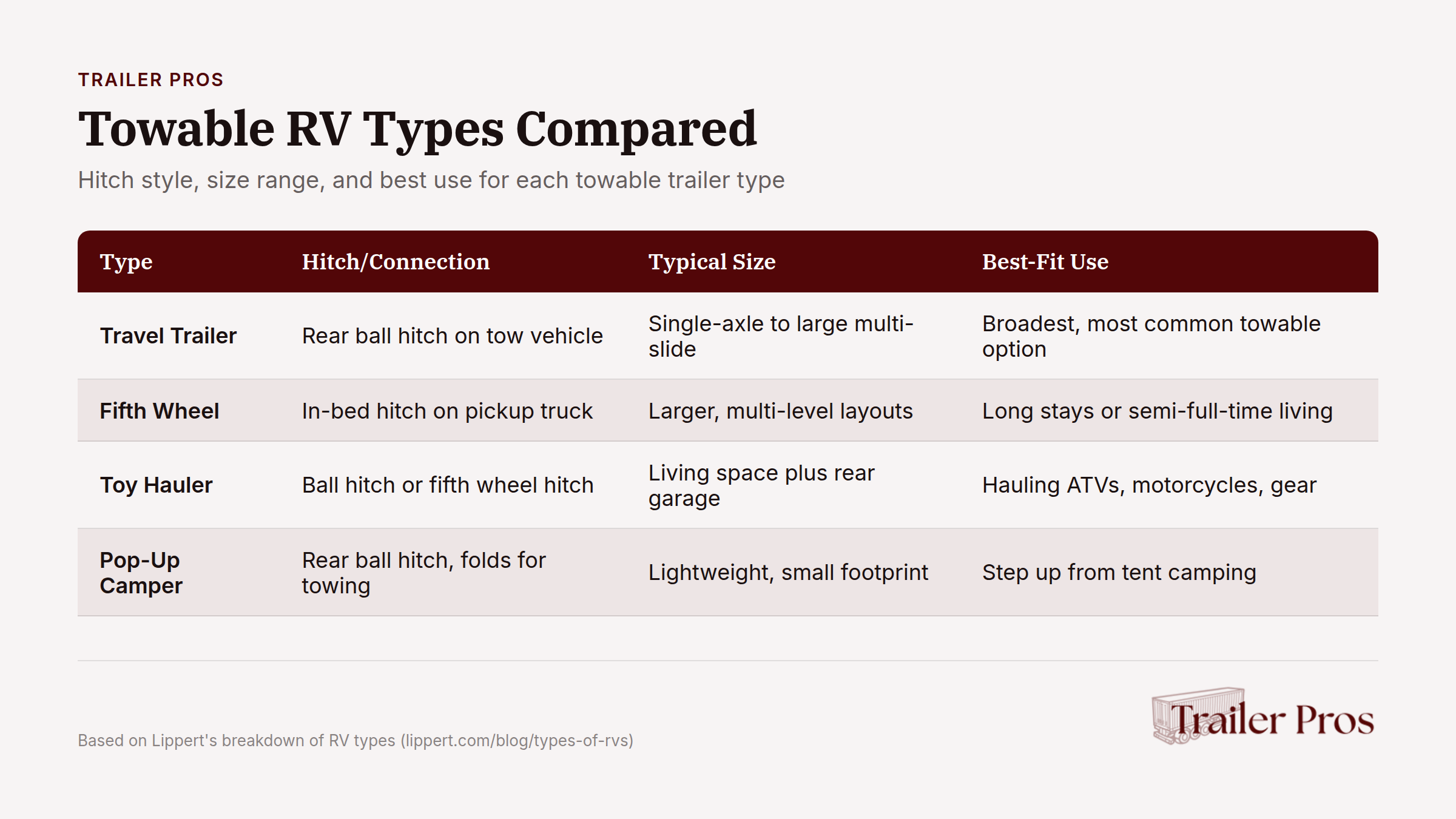
Towable RVs cover a wider range of shapes and hitch styles than most buyers expect, and each type serves a different kind of trip, per Lippert's breakdown of RV types.
- Travel trailer: Tows from a rear ball hitch on the tow vehicle. Sizes range from small single-axle units to large multi-slide models, and this is the broadest and most common towable category. Our travel trailer appraisal work covers this full size range.
- Fifth wheel: Connects via a special hitch mounted in the bed of a pickup truck, which places part of the trailer's weight over the rear axle. Fifth wheels tend to offer more residential-style interiors and multiple levels, which is why they're favored for long stays or semi-full-time living.
- Toy hauler: A travel trailer or fifth wheel with living quarters up front and a rear garage for ATVs, motorcycles, or other gear. Reinforced floors and a rear ramp door set these apart from standard trailers.
- Pop-up camper: A lightweight, foldable trailer that collapses for towing and expands at the campsite. Pop-ups are often the step between tent camping and a full travel trailer, valued for low weight and a small storage footprint.
Titling and Registration: Why RVs and Trailers Are Treated Differently
Motorized RVs are titled and registered as motor vehicles, while towable trailers are typically titled and registered as trailers or personal property, not as self-propelled vehicles. That single legal distinction drives most of the paperwork and insurance differences between the two.
Because a motorhome is a motor vehicle, it generally requires a valid driver's license to operate and carries liability insurance requirements similar to a passenger vehicle or light truck. A trailer, by contrast, usually needs its own title and plate in most states, but liability coverage often follows the tow vehicle rather than the trailer itself. Some states apply lighter registration fees and inspection requirements to camping trailers than to motorhomes, treating them more like utility or cargo trailers on the books.
Watch out: Rules vary meaningfully by state, so confirm directly with your state's motor vehicle agency whether your trailer needs its own plate, whether your tow vehicle's liability policy extends to the trailer, and how personal property tax applies where you live.
Which One Fits Your Travel Style?
Motorized RVs suit travelers who want to cover long distances or relocate frequently without disconnecting a living space from a tow vehicle each time. Class A and larger Class C motorhomes are common choices for extended, multi-week trips, seasonal snowbird migration, or full-time living on the road.
Towable trailers tend to fit weekend trips, holiday camping, and shorter regional travel better. Families moving up from tent camping often start with a travel trailer or pop-up, while fifth wheels and toy haulers see heavier use at destination campsites, motorsports events, or as a base camp for off-road vehicles. One practical advantage of a trailer: you can detach it at the campground and use your truck or SUV for the rest of the trip, something a motorhome owner can only do by towing a second vehicle behind the coach.
Maintenance and Lifespan: What to Expect from Each
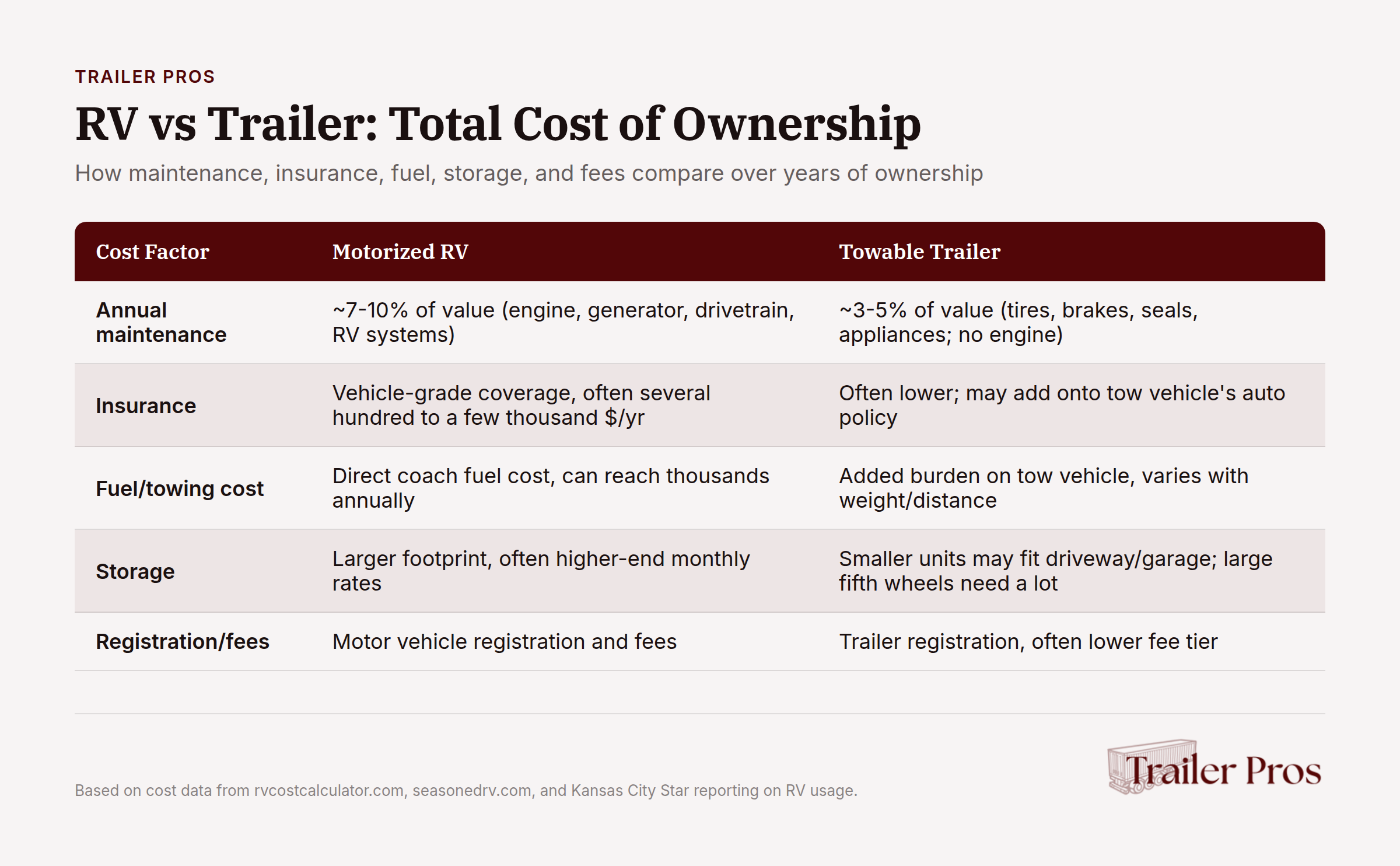
Motorized RVs generally cost more to maintain than towable trailers, and the gap comes down to the drivetrain. Annual maintenance on a motorhome, once you factor in the engine, transmission, generator, and slide-out systems alongside standard RV upkeep, often runs in the range of 7% to 10% of the rig's current value. Towable trailers, with no engine or transmission to service, typically run closer to 3% to 5% of value annually, concentrated in tires, bearings, brakes, suspension, roofing, and appliances.
Both motorhomes and trailers can last 15 to 20 years or more with careful upkeep, though the point at which repair costs outpace practical value (the true end of economic life) often arrives sooner than the structure's physical lifespan would suggest. Full-time use accelerates wear on both types, and climate exposure and build quality matter more to longevity than the RV class or trailer type alone.
Total Cost of Ownership: RV vs Trailer
The biggest financial gap between an RV and a trailer shows up over years of ownership, not at the point of sale. Depreciation, insurance, fuel, and storage all stack differently depending on whether you're driving the unit or towing it.
Depreciation hits both hard in the early years. RVs and trailers commonly lose 20% to 30% of value shortly after purchase and can retain roughly half their original price after 5 years, with towable units depreciating slightly more gently than motorized ones in percentage terms according to industry cost calculators. Fuel and insurance are where the categories diverge most: a motorhome carries its own fuel and drivetrain costs on top of vehicle-grade insurance, while a trailer's fuel cost shows up as extra load on the tow vehicle, and trailer insurance premiums tend to run lower since there's no engine or transmission at risk.
| Cost Factor | Motorized RV | Towable Trailer |
|---|---|---|
| Annual maintenance | Roughly 7% to 10% of value (engine, generator, drivetrain, plus RV systems) | Roughly 3% to 5% of value (tires, brakes, seals, appliances; no engine) |
| Insurance | Vehicle-grade liability and physical damage, often several hundred to a few thousand dollars a year | Often lower; may attach as an add-on to the tow vehicle's auto policy |
| Fuel/towing cost | Direct fuel cost for the coach, which can run into the thousands annually depending on mileage | Added fuel burden on the tow vehicle, varying with trailer weight and distance |
| Storage | Larger footprint (especially Class A), often the higher end of monthly storage rates | Smaller units may fit in a driveway or garage; larger fifth wheels still need a storage lot |
| Registration/fees | Motor vehicle registration and fees | Trailer registration, often at a lower fee tier in many states |
Put together, full ownership cost estimates for a motorized RV used regularly often land well into five figures a year once loan payments, insurance, fuel, maintenance, and storage are combined, according to public RV ownership cost breakdowns. Towable trailers typically land meaningfully lower on an annual basis, since they carry no engine to insure, fuel, or repair. One analysis of average usage patterns found that infrequent motorhome use (around 20 to 30 nights a year) drives the effective cost per night up sharply, a detail worth remembering if your travel plans are more occasional than constant, per reporting on typical RV usage.
Key takeaway: If your priority is minimizing ongoing cost and you already own a capable tow vehicle, a towable trailer usually wins on total cost of ownership. If you value an all-in-one driving and living experience and plan to use it often, a motorhome's higher cost may be worth the convenience.
Why the Motor Vehicle vs Personal Property Distinction Matters Later
The titling difference covered earlier doesn't disappear once you've bought and registered your rig. Because motorized RVs are legally and economically treated as motor vehicles, while towable trailers are treated as towed equipment or personal property, that distinction carries through into insurance claims, financing, estate and probate matters, and charitable donation paperwork.
A lender underwriting a motorhome loan will typically look at it much like a vehicle loan, while a trailer loan is often structured more like equipment or consumer goods financing, with different documentation expectations. An estate settling a motorhome may need to follow motor vehicle transfer procedures, while a trailer might be handled as general personal property. Insurance claims and donation deductions both rely on accurate, defensible valuations, and the right approach depends on which category your unit falls into.
If you're insuring, financing, settling an estate, or donating either type, it's worth having it appraised by someone who understands that an RV is valued as a motor vehicle and a trailer is valued as towed personal property. Getting that distinction right from the start avoids confusion later, whether you're working through an insurance claim, a loan application, or a trailer appraisal for loan collateral.