
Blog
Stolen Trailer Insurance Claim vs Bonded Title Liability: What Owners Should Know
A stolen trailer insurance claim recovers your loss, but a DMV bonded title creates a separate, ongoing liability if the trailer resurfaces later. This guide explains both exposures and why a written trailer appraisal supports each one.
When a cargo trailer, livestock trailer, or travel trailer disappears from a driveway or job site, most owners assume the story ends with an insurance check. It doesn't always. Filing a stolen trailer insurance claim settles the loss of the asset itself, but a second, entirely separate financial exposure can follow: liability tied to a DMV bonded title if the trailer is later recovered, resold, or becomes the subject of an ownership dispute. We prepare written trailer appraisal for insurance claims reports that document a trailer's value at the moment of loss, and understanding how that report interacts with both processes can save an owner from an unpleasant surprise years down the road.
This guide walks through what to do immediately after a theft, how insurers value a stolen trailer, what a bonded title surety bond actually protects against, and why these two financial tracks never share the same pool of money.
What to Do Immediately After a Trailer Theft
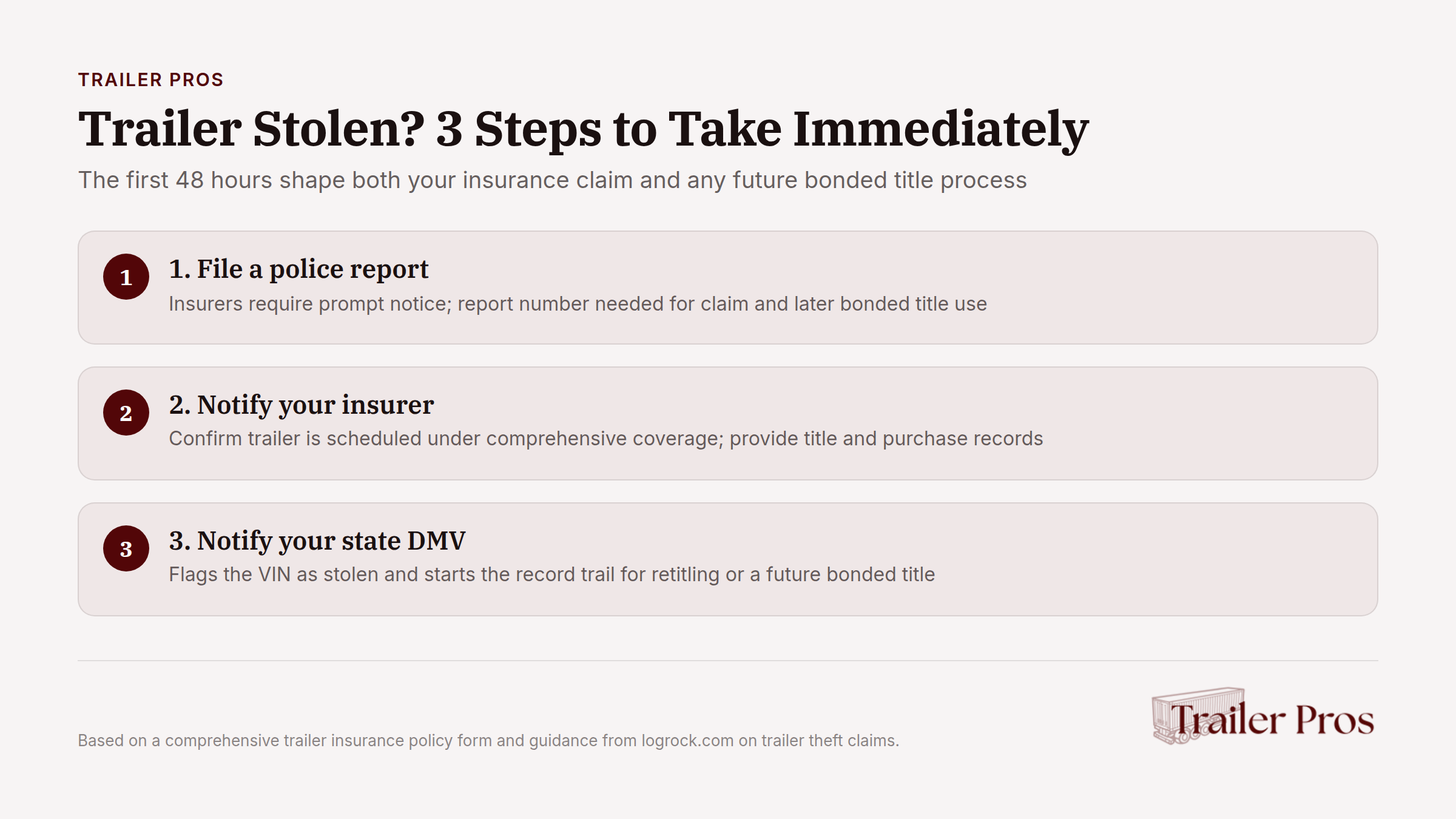
The first 48 hours after discovering a trailer missing determine how smoothly both the insurance claim and any future title questions will go. Acting in the right order protects your claim and creates the paper trail a bonded title process may require later.
- File a police report right away.
- Most insurance policies condition theft coverage on prompt notification to law enforcement, and some policies define a waiting period, commonly around four weeks, before an unrecovered trailer converts to a total loss, per one widely used comprehensive trailer insurance policy form.
- Keep the report number. You will need it for the insurer and, if the trailer later resurfaces, for any bonded title application.
- Notify your insurer without delay.
- Confirm the trailer was actually scheduled on your policy under comprehensive or physical damage coverage. A trailer theft insurance claim is only payable if theft is a covered peril and the trailer is specifically listed.
- Provide the title, purchase records, and any prior appraisal on file. Missing title paperwork is the single most common reason theft claim payments stall.
- Notify your state DMV or titling agency.
- This flags the trailer's VIN as stolen in state records, which matters if it is ever recovered, retitled, or sold. It also starts the record trail that supports a bonded title application if you or a future buyer ever need one.
How Insurers Document Ownership and Value for a Stolen Trailer Claim
Insurers settle a stolen trailer claim by verifying ownership, then paying out based on the trailer's value at the time of loss, minus your deductible. Most trailer and RV policies pay actual cash value (ACV) rather than a fixed agreed amount unless you specifically purchased scheduled or agreed-value coverage.
Progressive's guidance on RV theft coverage explains that comprehensive coverage can pay the fair market value of a stolen trailer, minus the deductible, but only if comprehensive coverage was active on the policy at the time of loss. Without it, theft simply is not a covered event, regardless of how the trailer was lost.
To document ownership and value, insurers typically want:
- The title or registration, showing you as the legal owner at the time of the theft.
- Purchase records, such as a bill of sale, loan payoff statement, or dealer invoice.
- A written appraisal, which establishes fair market value independent of the insurer's own estimate and gives the adjuster a defensible number to work from rather than a generic valuation tool.
An appraisal matters most when the trailer was customized (livestock trailers with upgraded stalls, food trailers with commercial kitchen builds, or RVs with aftermarket work), since standard depreciation tables built for stock trailers routinely undervalue those upgrades.
What Is a Bonded Title Surety Bond?
A bonded title surety bond is a financial guarantee a state DMV requires when someone applies to title a vehicle or trailer without a clean, verifiable chain of ownership, most often because the original title was lost, defective, or the trailer's history includes a theft. The bond does not protect the person who buys the bond. It protects everyone else.
As NFP's overview of the bonded title process explains, if a prior owner or lienholder later proves they have a superior claim to the trailer, they can file against the surety bond, and the surety investigates and pays that claimant up to the bond amount, not the current titleholder. That is the critical point owners miss: getting a bonded title does not make an ownership dispute go away. It just shifts who has to pay if the dispute is resolved against them.
Key takeaway: A bonded title lets you register and use a recovered or previously untitled trailer now, but it leaves you financially exposed for years if a true owner surfaces later. It is not a substitute for clean title, and it is not the same money as your insurance settlement.
This is exactly the scenario our trailer appraisal for bonded title service is built for: a written valuation that gives the DMV a defensible figure to size the bond, rather than a rough estimate that either overpays for coverage or leaves the bond too thin.
How the Bond Amount Is Set, and What Triggers a Claim Against It
A bonded title's bond amount is typically set as a multiple of the trailer's appraised value, though the exact multiplier varies by state. Practical guidance describes bonds set at roughly 1.5 times the vehicle's appraised value in states that use that method, while other states set bonds at 1x or as high as 2x value. In every version, the DMV needs a documented value figure before it can calculate the bond, which is why an independent appraisal is often a required part of the bonded title application, not an optional add-on.
A claim against the bond is triggered when a prior owner or lienholder comes forward, within the bond's active term, and proves they had a valid ownership or lien interest in the trailer that predates the bonded title. Jet Insurance Company's guidance on lost title bonds notes that these bonds generally remain active for around three years from the effective date, and a rightful owner can file a claim any time during that window. Once the bond term expires without a claim, that exposure ends.
If a claim is paid, the surety does not absorb the loss. The bonded titleholder has to reimburse the surety for whatever was paid out, which is the mechanism that makes bonded title liability a real dollar-for-dollar risk, not a formality.
Two Separate Exposures, Not the Same Money
It helps to think of these as two different accounts that never talk to each other. Your insurer pays for the loss of the trailer. The bond exists to pay a different party entirely, one who might show up years after your claim already closed.
| Insurance Claim | Bonded Title Liability | |
|---|---|---|
| Who pays | Your insurer, from your policy's comprehensive coverage | You, reimbursing the surety if a claim is paid against the bond |
| What triggers it | The trailer is stolen and not recovered within the policy's defined window | A prior owner or lienholder proves a valid claim during the bond's active term (often around 3 years) |
| Document that supports it | Title, purchase records, police report, written appraisal | Written appraisal (sets bond amount), state title application |
| Typical timeline | Weeks to a few months to settle | Bond stays active for years; claim can surface any time in that window |
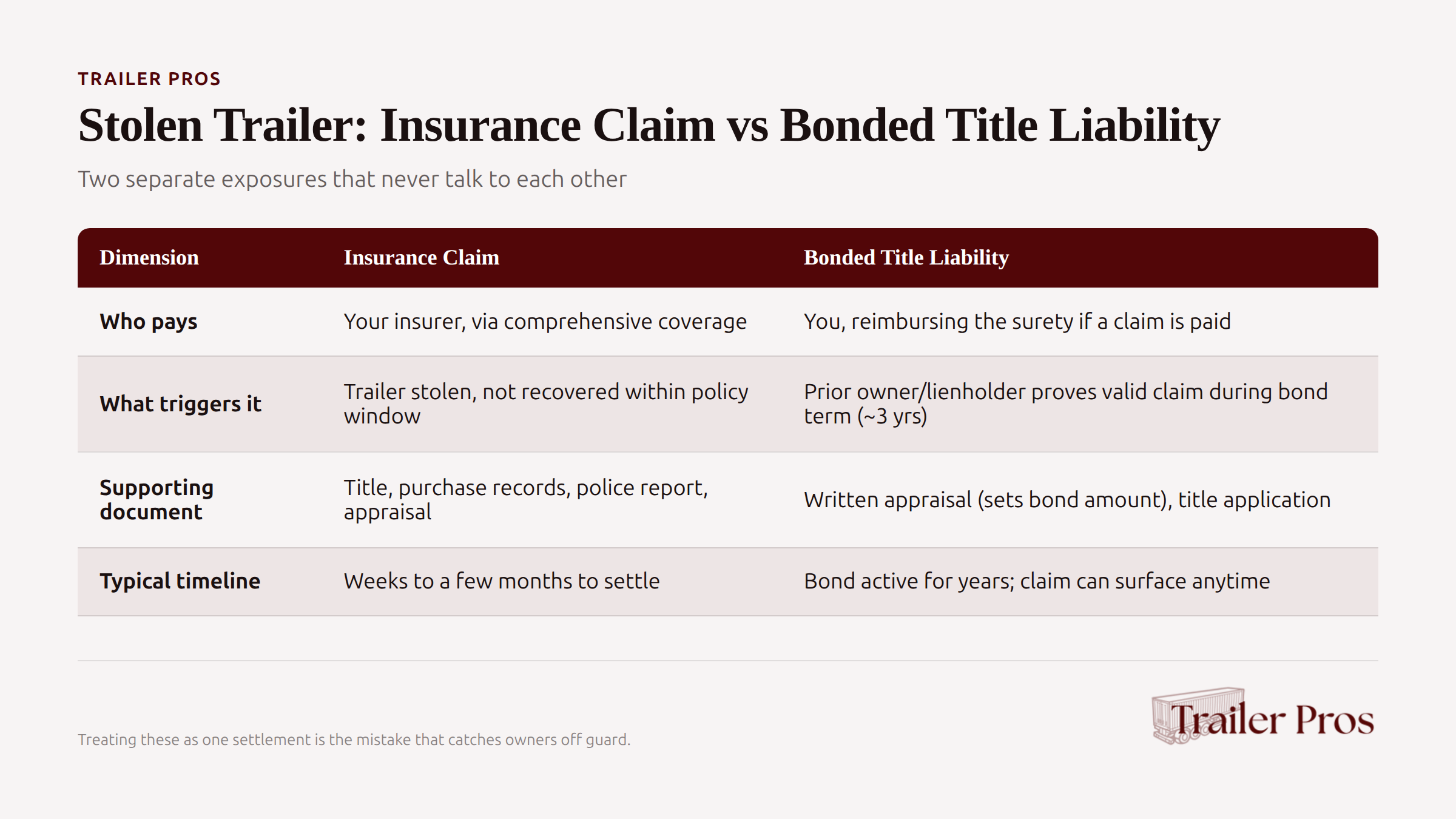
A trailer owner can collect a full insurance payout for a theft and, years later, still owe money to a surety company if the trailer resurfaces on a bonded title and a legitimate prior owner steps forward. The two processes run on separate tracks with separate paperwork, and treating them as one settlement is the mistake that catches owners off guard.
Why a Written Trailer Appraisal Supports Both Processes
A single written appraisal earns its keep twice in this scenario. For the insurance claim, it gives the adjuster an independent, defensible fair market value figure that accounts for the trailer's actual condition, upgrades, and market comparables, rather than a generic depreciation curve. For a bonded title, that same type of appraisal is often the document the DMV uses to calculate the bond amount, since the bond is generally sized as a multiple of appraised value.
Engagements for a trailer appraisal are quoted as a fixed fee, scoped before work begins rather than billed by the hour. For a standard trailer appraisal report, fees typically start from $195, with an IRS-qualified report starting from $295; most engagements fall between $195 and $495 depending on documentation available and the complexity of the trailer. That fee reflects the scope of the assignment, not the value of the trailer itself.
Watch out: Do not assume the value your insurer used to settle a theft claim will automatically satisfy a DMV's bonded title bond calculation later. The two agencies may want different documentation, and a stale or informal estimate rarely holds up if a bond claim is contested.
Protect Both Sides of a Trailer Theft Before It Happens
A stolen trailer insurance claim and a bonded title bond are not the same financial event, even though both can follow the same theft. The claim recovers what you lost. The bond protects someone else's claim against you, potentially for years afterward. Owners who keep a current written appraisal on file, along with title and purchase records, are in the strongest position on both fronts if a trailer ever goes missing.
If you need a defensible valuation for a theft claim, a bonded title application, or simply want documentation on file before trouble finds you, request a trailer appraisal from our team.
This article is provided for general informational purposes only and does not constitute legal, tax, or financial advice. Readers should consult a qualified attorney or insurance professional regarding their specific circumstances.