
Blog
Why Bankruptcy Filings Require a USPAP-Compliant Trailer Appraisal for Court and Creditors
A trailer appraisal for bankruptcy has to satisfy a trustee, a judge, and sometimes a secured creditor all at once, which is why the report needs to be USPAP-compliant. This guide explains which bankruptcy code sections drive the valuation, which standard of value applies, and what the report must state.
When a trailer shows up on a bankruptcy schedule, its value stops being a personal opinion and becomes a legal fact that a trustee, a judge, and possibly a secured creditor all have to rely on. That is a very different bar than a casual online estimate, and it is why bankruptcy courts consistently expect a USPAP-compliant trailer appraisal for bankruptcy rather than a dealer quote or a classifieds comparison.
What Bankruptcy Law Actually Requires From a Trailer's Value
Every individual bankruptcy filer lists personal property, including trailers, on Schedule A/B (Official Form 106A/B), and businesses use the equivalent Form 206A/B. That listed number is not just paperwork. It determines whether an exemption fully protects the trailer, whether a secured lender's claim is treated as secured or partly unsecured, and whether a trustee decides the asset is worth pursuing for the estate.
11 U.S.C. § 522(a)(2) defines value for exemption purposes as fair market value as of the date the petition is filed. That single date matters. A trailer's fair market value 6 months before filing or 6 months after does the debtor no good; the number has to be pinned to the petition date, which is one reason a generic value estimate rarely holds up under scrutiny.
Watch out: Debtors sometimes pull a number from an online marketplace listing and drop it straight onto Schedule A/B. That approach can work for low-value trailers with no dispute in sight, but once a trustee or secured creditor pushes back, an unsupported listing price offers no methodology to defend.
How Section 506 Changes the Standard of Value Mid-Case
Key takeaway: A single trailer can require two different value conclusions in the same bankruptcy case, one for the exemption analysis and a different one for the treatment of a secured claim.
Under 11 U.S.C. § 506, a secured creditor's collateral is valued "in light of the purpose of the valuation and of the proposed disposition or use of such property." In practice, that means the same trailer can carry a fair market value premise when the debtor intends to keep and use it, and an orderly or forced liquidation value premise when the trailer is headed for a trustee's sale. Federal court guidance on valuing collateral in bankruptcy confirms this dual approach: the standard of value follows the intended use of the asset in the case, not a single fixed number.
Example: A debtor in Chapter 13 wants to keep a livestock trailer that secures a lender's lien. The court values it at fair market value to set the secured claim for plan payments. If the same case later shifts toward liquidation because the plan fails, that same trailer may need a fresh orderly liquidation value to reflect what a trustee's sale would actually generate.
This is also where a single-premise appraisal falls short. An appraiser working a bankruptcy file often has to state more than one value conclusion for the same asset, on the same effective date, because the bankruptcy code itself asks two different questions of the property.
What a USPAP-Compliant Trailer Appraisal Must State
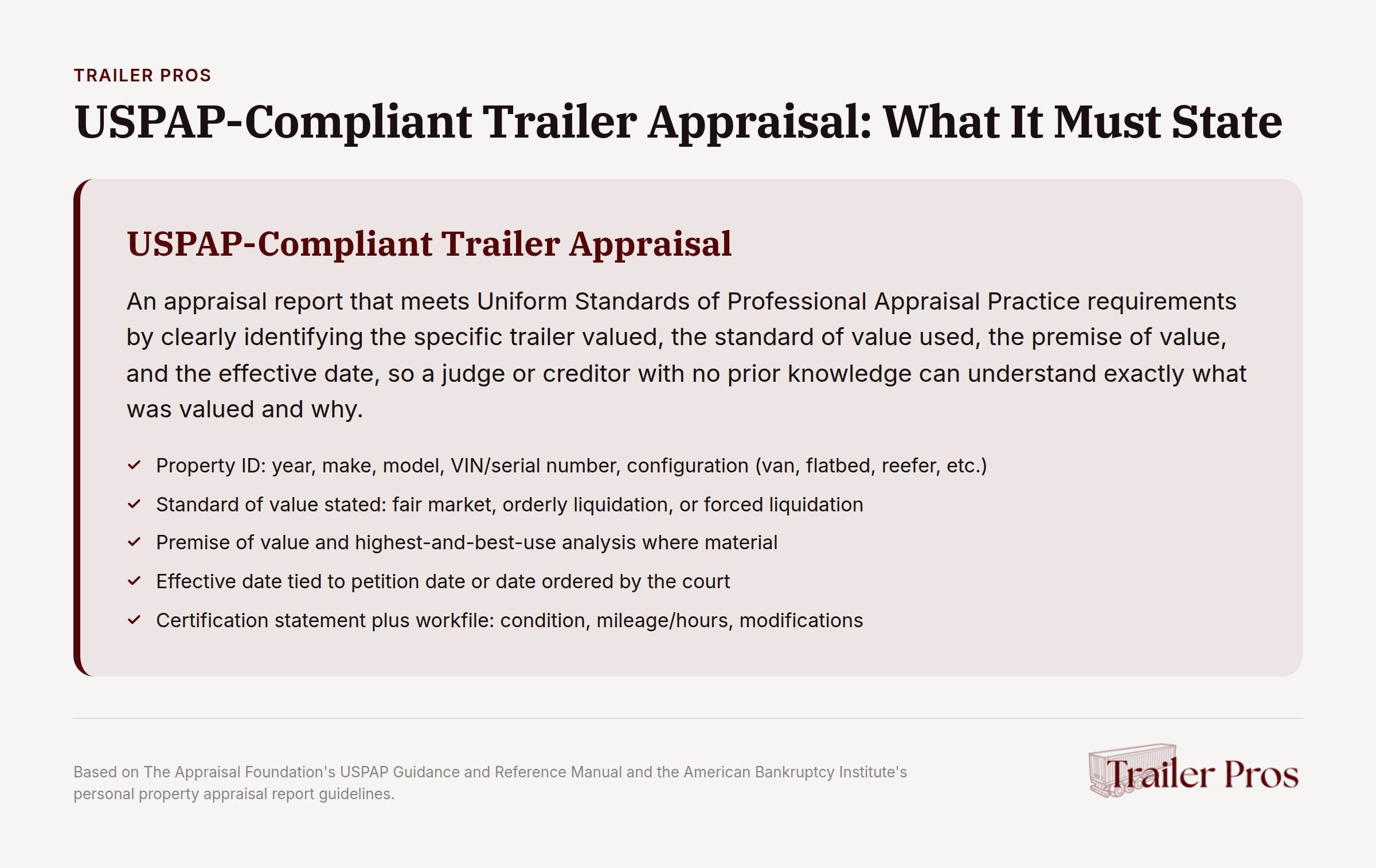
The Uniform Standards of Professional Appraisal Practice, published by The Appraisal Foundation, requires an appraiser to identify the specific property being valued, the standard of value applied (fair market value, orderly liquidation value, or forced liquidation value), the premise of value, and the effective date of the opinion. USPAP's guidance and reference materials set out these disclosure requirements so that anyone reading the report, including a judge who has never seen the trailer, can understand exactly what was valued and why.
For personal property specifically, appraisal guidance aimed at bankruptcy practitioners notes that a highest and best use analysis is expected wherever it is material to the asset, along with a defined scope of work and a certification statement, as outlined in personal property appraisal report guidelines published by the American Bankruptcy Institute. A trailer appraisal built for bankruptcy typically documents:
- Year, make, model, VIN or serial number, and configuration (dry van, flatbed, reefer, livestock, or specialty)
- Condition, mileage or hours of use, and any modifications or damage
- The standard and premise of value being applied, and why
- The effective date tied to the petition date or the date ordered by the court
- A certification statement and a workfile supporting the conclusion
How Trustees Use Trailer Appraisals Across Chapter 7, 11, and 13
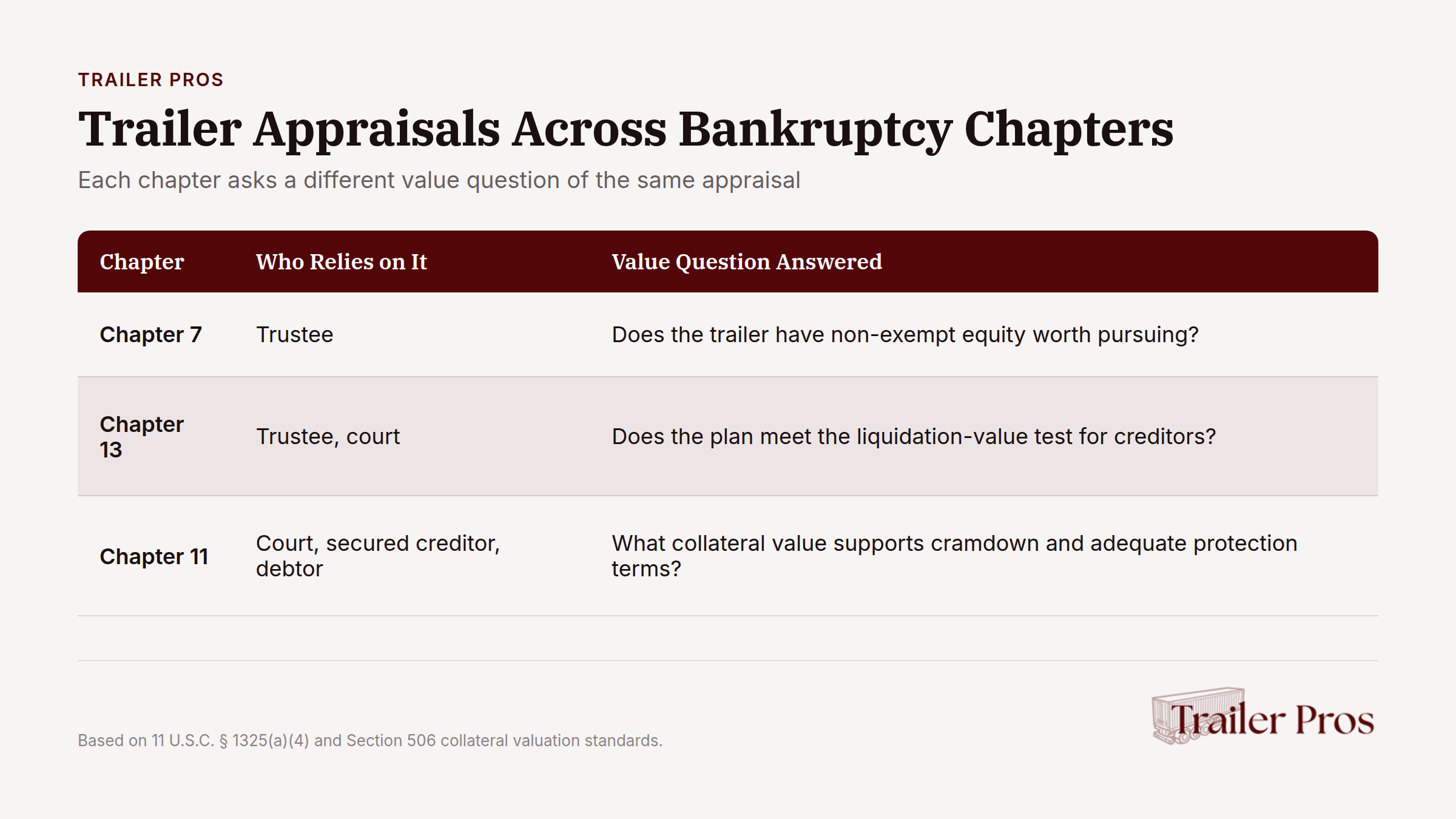
The purpose a trustee needs a trailer valued for shifts depending on which chapter the case falls under, and the appraisal has to be scoped to match.
In Chapter 7, guidance for trustees directs them to weigh fair market value against available exemptions to decide whether a trailer has enough non-exempt equity to justify pursuing it for the estate. If the numbers are close or contested, the trustee may need a professional appraisal rather than relying on the debtor's own schedule.
In Chapter 13, the case has to satisfy the "best interests of creditors" test under 11 U.S.C. § 1325(a)(4), which requires a liquidation analysis showing creditors would receive at least as much under the plan as they would in a Chapter 7 liquidation. That analysis depends on a defensible liquidation value for personal property like trailers, not just a fair market estimate.
In Chapter 11, appraised value drives collateral valuation under Section 506, sets the terms of a cramdown on a secured creditor, and supports adequate protection payments while the case proceeds. A business with a fleet of trailers on its balance sheet may need each unit valued individually or as a group, depending on how the plan treats the collateral.
| Chapter | Who relies on the appraisal | Value question being answered |
|---|---|---|
| Chapter 7 | Trustee | Does the trailer have non-exempt equity worth pursuing? |
| Chapter 13 | Trustee, court | Does the plan meet the liquidation-value test for creditors? |
| Chapter 11 | Court, secured creditor, debtor | What collateral value supports cramdown and adequate protection terms? |
How a Bankruptcy Trailer Appraisal Differs From Other Purposes
A trailer appraisal is not a one-size-fits-all document; the intended use shapes the entire assignment. A trailer appraisal for an insurance claim centers on damage or loss tied to a specific event and a specific carrier's policy, with the effective date set to the date of loss. A trailer appraisal for divorce centers on equitable distribution between two parties as of the date the marriage dissolved, with a single fair market value premise typically satisfying both sides.
Bankruptcy is different on both counts. The report serves the trustee, the court, and often a secured creditor simultaneously, and it may need to state more than one value premise, fair market value alongside orderly or forced liquidation value, within the same engagement. According to nonprofit bankruptcy resource guidance, debtors often start with market listings like Blue Book or NADA figures, but a trustee who believes the listed value is too low may bring in a professional appraiser or auctioneer to test that number before the case proceeds further.
Ordering a Trailer Appraisal for a Bankruptcy Case
Because a bankruptcy trailer appraisal has to meet a court's evidentiary expectations, the appraiser needs the case context up front: which chapter the filing falls under, the petition date, whether a secured creditor is disputing value, and whether the trustee needs fair market value, liquidation value, or both. Reports built for identification purposes alone, without VIN verification, condition detail, and a stated standard of value, tend to invite challenge exactly when the case gets contested, as general guidance for trailer identification and condition documentation points out for fleet operators facing similar scrutiny.
For a trailer, this engagement is quoted as a fixed fee after the appraiser reviews the case and the number of units involved, starting from $195 for a standard report and $295 for an IRS-qualified or advanced report, with typical assignments running $195 to $495 and highly complex fleet or disputed-value cases running higher. The fee reflects the number of trailers, the depth of documentation required, and whether multiple value premises are needed, never the trailer's market value itself.
Pro tip: If a case is likely to move from a debtor keeping the trailer to a trustee liquidating it, ask the appraiser to address both fair market value and liquidation value in the same report. Ordering a second appraisal later, after the case posture changes, costs more time than most Chapter 13 or Chapter 11 timelines can absorb.
A trailer's value in bankruptcy is rarely a single number and never a casual guess. Getting a USPAP-compliant report early, scoped to the chapter and the specific legal question at hand, gives the debtor, the trustee, and the court a figure that can actually hold up when someone in the case decides to challenge it.
This article is provided for general informational purposes only and does not constitute legal, tax, or financial advice. Readers should consult a qualified attorney or CPA regarding their specific circumstances.