
Blog
Why Trailer Appraisals for Probate Use Equipment Valuation, Not Blue Book Pricing
A trailer appraisal for probate rarely comes from Kelley Blue Book or NADA guides, because cargo, utility, and dump trailers get valued like equipment, using cost and sales comparison approaches tied to the decedent's date of death. This guide explains why, what documentation executors need to gather, and how the fee gets quoted.
When a cargo trailer, utility trailer, or dump trailer shows up on an estate inventory, the executor's first instinct is usually to look up the value the same way they would a car: pull a number from an online guide and move on. That approach falls apart fast with trailers, and a probate court or the IRS will notice. This guide walks through why trailers get valued more like equipment than passenger vehicles, what the trailer appraisal for probate process actually involves, and what heirs and personal representatives need to have ready before the appraiser starts.
Why Blue Book Guides Don't Work for Cargo and Utility Trailers
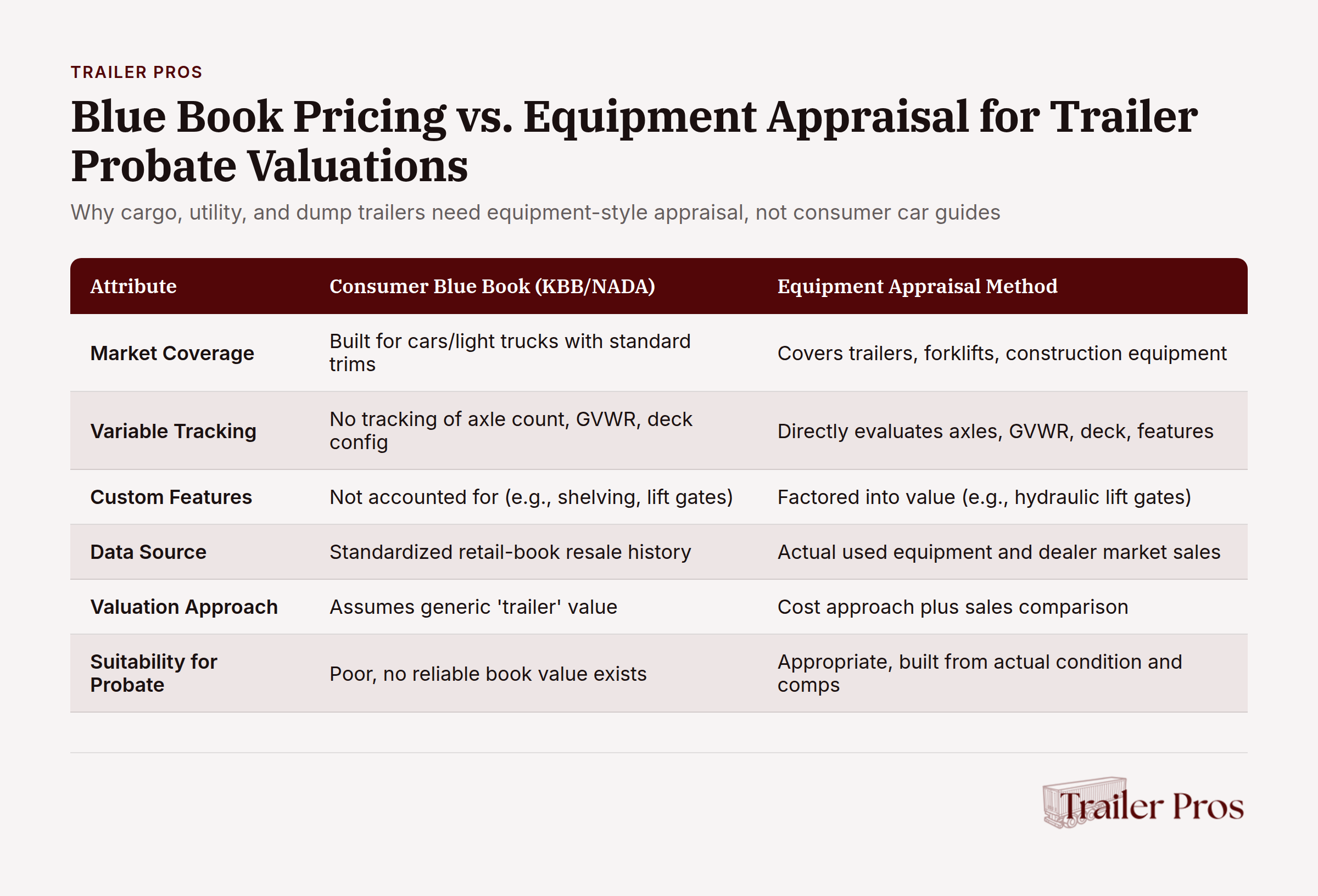
Consumer pricing guides like Kelley Blue Book and NADA were built to price passenger cars and light trucks, vehicles that roll off assembly lines in a handful of trim levels with well-documented resale histories. Trailers don't fit that mold. A 20-foot gooseneck dump trailer, a enclosed cargo trailer with a custom shelving buildout, and a tandem-axle utility trailer with a hydraulic lift gate can differ enormously in axle count, GVWR, deck configuration, and mechanical features, and no standardized retail-book market tracks all of those variables the way it tracks a Honda Accord.
Because there's no reliable book value to pull from, an appraiser working a trailer for an estate has to build the value from the ground up, the same way a machinery and equipment appraiser would value a forklift or a piece of construction equipment. That means looking at what the trailer actually is, what condition it's in, and what similar units are actually selling for in the used equipment and dealer market, not what a generic vehicle guide assumes a trailer is worth.
The Appraisal Methodology Courts Expect: Cost Approach and Sales Comparison
A probate court and the IRS both expect a trailer's value to be developed using recognized appraisal methodology, not a guess. In practice, that means two approaches, often used together.
The cost approach starts with the replacement cost of a new trailer of the same type and configuration, then subtracts for physical deterioration (wear, rust, tire and axle condition), functional obsolescence (outdated features or configurations that no longer match buyer demand), and economic obsolescence (market conditions that depress values across the category). This is the same framework used across our machinery & equipment appraisal work for tractors, forklifts, and construction equipment, and it applies just as directly to a dump trailer or gooseneck flatbed.
The sales comparison approach looks at actual transactions: recent sales and asking prices for comparable trailers pulled from used equipment dealers, trailer-specific auction results, and regional classified listings. An appraiser adjusts those comparables for differences in age, axle configuration, box or deck size, hydraulic components, and overall condition until they land on a supportable number for the specific trailer in the estate.
Used together, these two approaches produce a value that reflects the trailer's actual resale market, the used equipment and dealer channel where trailers really change hands, rather than a number lifted from a passenger-vehicle guide that was never built to cover this asset class.
Pro tip: If the estate includes more than one trailer (say, a utility trailer and a horse trailer), ask whether each should be reported as its own line item. Distinct trailer types often have distinct comparable markets, and lumping them together can weaken the supportability of the reported values.
What "Fair Market Value" Means for a Trailer in an Estate
For probate and estate tax purposes, a trailer is valued at its fair market value as of the decedent's date of death, the price a willing buyer and willing seller would agree to, with neither under pressure to act and both reasonably informed about the trailer's condition and market. This is the same standard IRS Publication 559 applies to property inherited from a decedent generally, and it is the standard executors are expected to use when they list tangible personal property, including trailers, on the estate inventory.
The federal estate tax regulations that define how property in a gross estate gets valued (26 CFR Section 20.2031-1(b), with Section 20.2031-6 addressing household and personal effects specifically) set out this same willing buyer, willing seller framework, along with related IRS revenue procedures describing how tangible personal property should be documented and reported. None of these rules single out trailers for special treatment. They simply require that the value be defensible, tied to an actual market, and pinned to the correct date.
If the estate is large enough to require a federal estate tax filing, the trailer's appraised value gets reported alongside other estate assets on the relevant Form 706 schedule, and the IRS Instructions for Form 706 describe the same date-of-death valuation standard that governs the rest of the estate. There's no special estate-tax carve-out for trailers; they're treated like any other item of tangible personal property, valued at fair market value and documented accordingly.
Watch out: Trade-in offers from dealers are almost always lower than fair market value because they build in the dealer's resale margin. An appraiser can use a dealer quote as one data point, but it should never be the only number behind a probate valuation.
Documentation Executors and Heirs Need to Gather
Before an appraiser can develop a defensible fair market value, they need enough information to properly identify the trailer and confirm they're working with the estate's proper representative. Gathering this ahead of time speeds up the engagement considerably.
Executors and heirs should have the following ready:
- Title or registration and VIN for the trailer, so the appraiser can confirm the exact make, model, and configuration being valued.
- The decedent's death certificate, which establishes the valuation date the appraisal must reflect.
- Letters testamentary or the equivalent document appointing the executor or personal representative, which confirms the appraiser is engaging with someone who actually has authority over the estate's assets.
- Photographs showing the trailer's overall condition, including any custom modifications, hydraulic components, or damage that would affect value.
- Maintenance or repair records, if available, since documented upkeep supports a stronger condition rating.
- Any prior purchase records, such as a bill of sale or dealer invoice, which give the appraiser a useful reference point even though the appraisal itself must reflect current fair market value.
A law firm resource on probate valuation makes a similar point for other hard-to-price assets: when standard pricing guides don't cover the item, the valuation has to be built from comparable sales, condition documentation, and, where the asset is unusual or high-value, an independent appraisal. Trailers fall squarely into that category.
How the Trailer Fits Into the Broader Estate Inventory
A trailer is rarely the only asset an estate needs valued. It typically sits alongside household contents, other vehicles, and sometimes farm or business equipment, and each of those categories has its own appropriate valuation approach. General guidance on valuing property for probate reinforces that different asset types call for different methods, and a court or the IRS expects the inventory to reflect that rather than applying a single blanket approach across everything the decedent owned.
Because of this, a trailer is usually quoted and reported as its own line item, separate from general household personal property, especially if it is a commercial-use asset like a cargo trailer used in a small business, or if the estate also requires a trailer appraisal for estate tax filing alongside the probate inventory. Keeping the trailer's valuation distinct makes the report easier for the court, the beneficiaries, and, if it comes up, an IRS examiner to follow.
Key takeaway: Treat the trailer as its own appraisal assignment with its own documentation, market comparables, and reported value, rather than folding it into a general personal property estimate.
What a Trailer Appraisal for Probate Costs
Our trailer appraisals for probate and estate purposes start at $195 for a standard report and $295 for an advanced, IRS-qualified report, with most engagements falling between $195 and $495 depending on the trailer's complexity and the depth of documentation available. Estates with unusual, heavily modified, or high-value trailers, or those requiring multiple trailers appraised as a set, can run higher, typically $1,800 to $4,500 or more.
Every engagement is quoted as a fixed fee before work begins, based on the scope of the assignment: the trailer's complexity, how complete the available records are, whether the report needs to meet IRS-qualified standards for an estate tax filing, and how much analysis the sales comparison and cost approach work requires. The fee is never based on how much the trailer turns out to be worth, and it is never billed hourly.
Working With the Right Appraiser for a Probate Trailer
Because trailers get valued using equipment appraisal methodology rather than consumer vehicle pricing, it matters that the appraiser handling the assignment has the right background. Appraisers who specialize in machinery and equipment typically hold credentials with organizations such as the ASA, CAGA, and NEBB, and every report should be prepared in accordance with USPAP, the professional standard that governs how personal property and equipment appraisals are developed and documented.
Before any work begins, the appraiser should also confirm they're dealing with the estate's proper representative, whether that's the named executor, an administrator appointed by the court, or another party with documented authority, consistent with standard probate appraisal practice. This protects the estate, the appraiser, and the eventual accuracy of the report.
If your estate includes a cargo trailer, utility trailer, dump trailer, or any other non-standard trailer, gathering the title, death certificate, appointment paperwork, and condition photos ahead of time will make the appraisal move faster and give the court, the IRS, or the beneficiaries a number they can actually rely on.
This article is provided for general informational purposes only and does not constitute legal, tax, or financial advice. Readers should consult a qualified attorney or CPA regarding their specific circumstances.