
Blog
Can You Deduct a Trailer Casualty Loss on Your Taxes After Theft or Bankruptcy?
A stolen or storm-damaged trailer only produces a tax deduction in narrow circumstances, while a trailer caught up in bankruptcy is a valuation question, not a write-off. This guide walks through both rules with worked examples so you know which one applies to you.
If your trailer was stolen, destroyed in a storm, or is sitting on a bankruptcy schedule right now, you are probably asking two different questions at once: can I write this off on my taxes, and what is this thing actually worth. Those are separate problems governed by separate rules, and mixing them up is the fastest way to misreport a loss or underreport an asset. This guide walks through the tax-deduction rules for a stolen or damaged trailer, then covers how bankruptcy valuation works on its own terms.
Two Different Questions, Two Different Rules
A casualty or theft loss deduction is a tax question: did you lose value, and does the law let you claim it against your income. A bankruptcy schedule value is a disclosure question: what would this trailer sell for today, regardless of what you paid for it or what you still owe. An insurance claim after a storm or theft calls for our trailer appraisal for insurance claims service, while a filing that requires an accurate petition-date figure calls for our trailer appraisal for bankruptcy service. Keep that line between the two clear, because the rest of this article treats them separately on purpose.
Does a Stolen or Destroyed Trailer Qualify for a Casualty Loss Deduction?
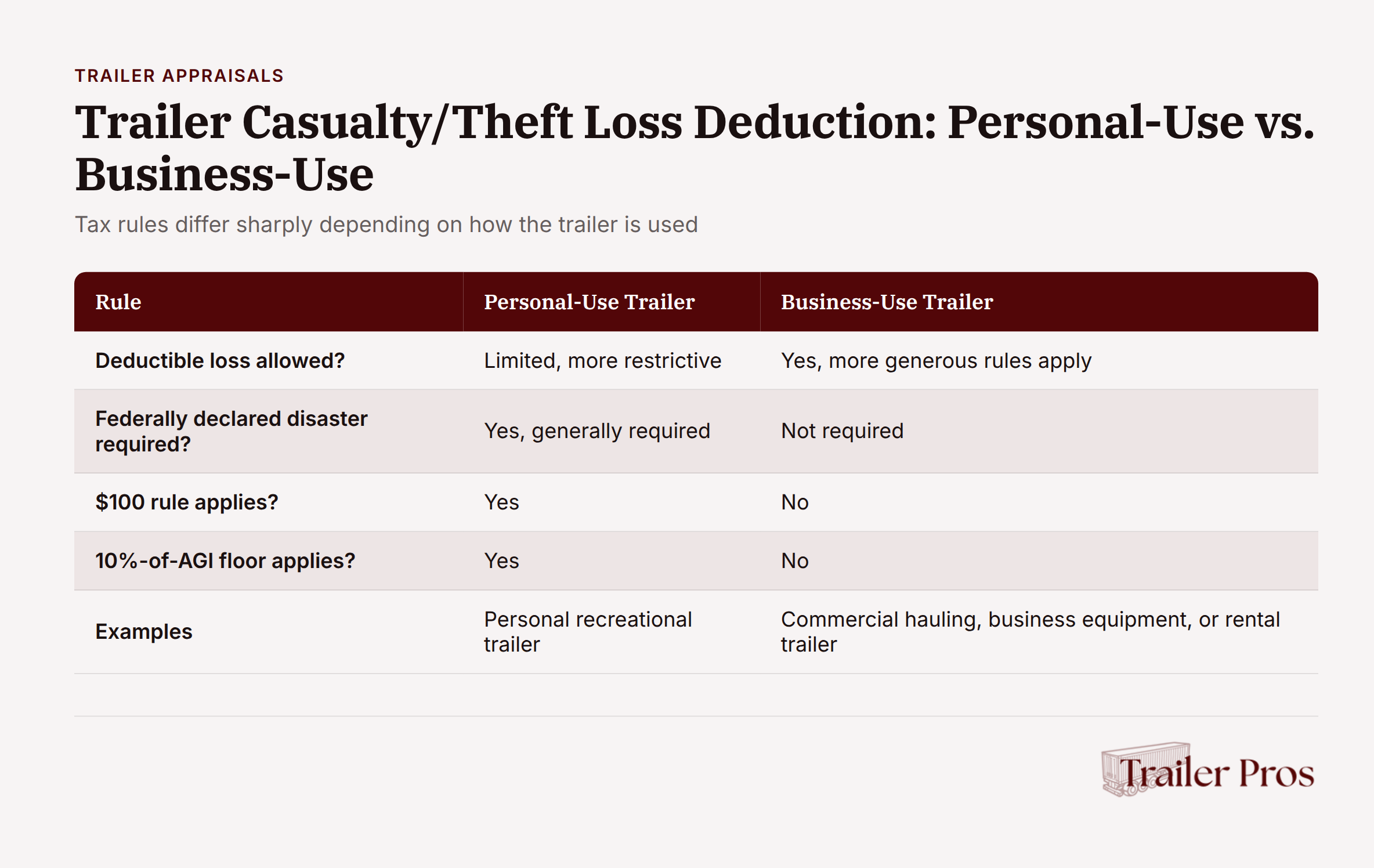
For most individual owners, the answer is no. Since the Tax Cuts and Jobs Act took effect, a personal-use casualty or theft loss is deductible only if it is attributable to a federally declared disaster, a limitation that runs through the 2025 tax year, as described in IRS Tax Topic 515. A camper stolen from a storage lot or a utility trailer vandalized in your driveway does not qualify for a deduction under current law unless the loss is tied to a disaster the federal government has formally declared.
Personal-Use Trailers: The Federally Declared Disaster Requirement
If your travel trailer was destroyed in a hurricane, wildfire, or flood that received a federal disaster declaration, you may be able to claim a casualty loss. The loss is reported on IRS Form 4684, and the amount is calculated under the rules in IRS Publication 547. Two additional limits apply to personal-use property before anything is deductible:
- The $100 rule: the first $100 of loss per incident is never deductible, no exceptions.
- The 10% rule: the remaining loss is deductible only to the extent it exceeds 10% of your adjusted gross income (AGI) for the year.
Watch out: these two floors eliminate a deduction far more often than owners expect. A loss that feels significant on paper can still net to zero once the 10%-of-AGI floor is applied.
Business-Use Trailers Play by Different Rules
If the trailer is used in a trade or business, a different and considerably more generous set of rules applies. A business or income-producing trailer can generate a deductible casualty or theft loss even when the event is not a federally declared disaster, and the loss is not reduced by the $100 rule or the 10%-of-AGI floor that apply to personal property. A commercial hauling trailer, a business-owned equipment trailer, or a rental trailer used to generate income falls into this category rather than the personal-use bucket.
How to Calculate a Trailer Casualty Loss (Worked Example)
For a casualty (storm, fire, accident, not theft), the deductible amount is the smaller of the trailer's decrease in fair market value or its adjusted basis, per Publication 547. Adjusted basis generally starts with the original purchase price and is adjusted for improvements, following the general basis rules published by the IRS.
Example: A travel trailer has an adjusted basis of $10,000. A federally declared flood drops its fair market value from $9,000 to $1,000, a decrease of $8,000. Because $8,000 is smaller than the $10,000 basis, the starting loss is $8,000. The owner's insurer reimburses $2,000, leaving $6,000. Subtract the $100 floor: $5,900. The owner's adjusted gross income is $40,000, so the 10% floor is $4,000. The deductible casualty loss is $5,900 minus $4,000, or $1,900.
Change one variable and the outcome flips. If that same owner's AGI were $65,000 instead, the 10% floor would be $6,500, which exceeds the $5,900 remaining loss, and the deductible amount would drop to zero. The math rewards owners who document every number precisely, not just the headline damage figure.
How to Calculate a Trailer Theft Loss (Worked Example)
Theft works differently because, once the property is gone, its fair market value immediately after the event is treated as zero. The deductible theft loss is the smaller of the trailer's fair market value immediately before the theft or its adjusted basis, following the same Publication 547 framework used for casualties, and it is reported through the same Form 4684 process.
Example: A utility trailer with a $9,500 adjusted basis is stolen during a declared disaster evacuation, when its fair market value was $9,000. The smaller figure, $9,000, is the starting loss. Insurance pays $5,000 after a timely claim, leaving $4,000. Subtract the $100 floor: $3,900. If the owner's AGI is $50,000, the 10% floor is $5,000, well above $3,900. The deductible theft loss in this scenario is $0, despite real financial harm, because the AGI floor absorbed the entire remaining loss.
Pro tip: a timely insurance claim is not optional if you want to preserve any deduction for the uninsured portion. The IRS requires that claim to have been filed before the uncovered balance becomes deductible; only a true deductible or genuinely uncovered amount escapes that requirement.
Why an Appraisal Matters for a Casualty or Theft Claim
The IRS methodology depends entirely on fair market value immediately before and immediately after the loss (or immediately before a theft), and the agency points taxpayers toward competent appraisal help to establish that figure defensibly. A documented opinion of value, dated to the loss event and tied to comparable sales, holds up far better under review than a owner's estimate or a used-trailer listing pulled after the fact.
An IRS-qualified trailer appraisal is quoted as a fixed fee once we understand the trailer's type, condition, and documentation, with pricing that starts at $295 for IRS-qualified reporting and typically runs $195 to $495 depending on scope; larger or more complex trailers can run higher. The fee reflects the complexity of the assignment and the depth of analysis required, never the dollar value of the trailer itself. The Publication 584 casualty loss workbook walks through the same schedules an appraiser's report should support.
Bankruptcy: Your Trailer's Value Isn't a Deduction, It's a Disclosure
A repossession, surrender, or loss of a trailer inside a bankruptcy case is not automatically a casualty or theft for tax purposes. A loss arising from theft is specifically carved out of the casualty-loss regulation itself, as 26 CFR § 1.165-7 makes clear, and bankruptcy outcomes more often involve cancellation-of-debt income, foreclosure, or disposition rules that are analytically separate from Form 4684. A debtor cannot turn an unpaid trailer loan balance into a casualty deduction simply because a bankruptcy court discharged the debt.
What bankruptcy does require is an accurate, defensible value for the trailer as of the petition date, the date you filed, not the purchase price, the loan payoff, or what a dealer quoted you last year. That figure goes on Schedule A/B and reflects what the trailer would bring in a cash sale or liquidation on that specific date.
A qualified appraisal is not mandatory for every trailer on a bankruptcy schedule, but it becomes important in several recurring situations:
- The trailer has unusual features, custom work, or commercial specifications that general listing sites don't price well.
- Comparable market data is thin, conflicting, or seasonal.
- A claimed exemption depends on a narrow equity margin where a few hundred dollars matters.
- The trustee questions the scheduled value or requests independent documentation.
- The trailer is damaged, non-running, or otherwise hard to value from standard comparables.
Key takeaway: a bankruptcy trustee is not bound by whatever figure a debtor writes on the schedule. A trustee can request documentation, inspect the trailer, commission an independent appraisal, and object to an exemption or pursue turnover if undisclosed equity turns up later. Our trailer appraisal for bankruptcy guide on USPAP compliance covers what a court-ready report needs to include: valuation date, condition, comparable data, assumptions, and appraiser qualifications, all tied to the petition date rather than the appraisal date.
Debtors protect themselves by listing the trailer specifically (make, model, year, and VIN), reporting a defensible petition-date value, disclosing any secured debt against it, and keeping the supporting evidence, photographs, comparable listings, and lien statements, in case the trustee asks questions later.
Know Which Track You're On
A stolen or storm-damaged personal trailer almost never produces a tax deduction unless a federal disaster declaration covers the event, and even then the $100 and 10%-of-AGI floors can zero it out. A business-use trailer plays by more forgiving rules. Bankruptcy is a different exercise entirely: it asks what the trailer is worth today, not what you lost or what the government will let you deduct. Getting a documented, defensible value, whether that's a decrease in fair market value for a casualty claim or a petition-date figure for a bankruptcy schedule, is the thread that runs through both situations.
This article is provided for general informational purposes only and does not constitute legal, tax, or financial advice. Readers should consult a qualified attorney or CPA regarding their specific circumstances.