
Blog
Trailer Park Chattel Appraisal: What It Means When You Own the Home, Not the Land
A trailer park chattel appraisal values the manufactured home you own separately from the land you rent, and getting that distinction right determines whether your financing, insurance, or divorce settlement holds up. This guide covers what chattel means, how the appraisal process differs from a real estate valuation, and the moments when residents actually need one.
If you own a mobile home or manufactured home sitting on a rented lot in a trailer park, the appraisal you need looks nothing like the one your neighbor gets for a house on owned land. A trailer park chattel appraisal values the home only, as personal property, because the ground underneath it belongs to the park, not to you. That distinction shapes what loan program you qualify for, how your insurer writes the policy, and how a probate court or divorce judge divides the asset. Here is what chattel means in this setting, how the appraisal itself differs from a real estate appraisal, what actually drives the number, and when residents typically need one.
What Does "Chattel" Mean When You Own the Home but Not the Land?
Chattel is simply the legal term for movable personal property, and in a trailer park it separates the home you own from the land you rent. A manufactured or mobile home on a leased lot is titled the way a vehicle is titled, through a state motor vehicle department or manufactured housing titling agency, rather than deeded the way a house on owned land would be. There is no land component to record because there is no land ownership to record.
That titling status carries through to the appraisal itself. Guidance on manufactured home titling from the National Consumer Law Center confirms that homes titled as personal property, or sitting on leased land, are appraised using manufactured housing valuation guides and comparable chattel sales rather than the standard real-estate comparable sales approach used for a land-and-home package. A qualified personal property appraiser develops and reports this kind of valuation in accordance with USPAP Standards 7 and 8, the sections of the Uniform Standards of Professional Appraisal Practice that govern personal property appraisal and reporting.
Key takeaway: the home in a trailer park is an asset in its own right, separate from the land it sits on, and it gets appraised, financed, insured, and divided in a divorce or estate as personal property, not real estate.
Why the Personal Property vs Real Property Split Changes Everything
Because the home is chattel and not real property, financing, insurance, taxation, and dispute resolution all follow a different set of rules than they would for a site-built house.
Financing: A Chattel Loan Is Not a Mortgage
A chattel loan is secured by the home alone, not by a deed to land, which means it is structured differently from a conventional real estate mortgage from the start. Federal programs recognize this split explicitly: FHA's Title I program finances manufactured home units as chattel collateral, separate from any lot loan. For certain high-cost manufactured home loans, federal lending rules require the creditor to obtain a written appraisal performed by a licensed or certified appraiser who physically inspects the home's interior, and to deliver a copy of that appraisal to the borrower at least three business days before closing, according to Fannie Mae's legal summary of manufactured home chattel lending rules. Residents pursuing a chattel loan or refinance on a trailer will almost always run into this requirement, and lenders rely on the appraisal to confirm the home's value independent of the land.
Insurance Coverage Follows the Title
A chattel-titled home in a park is typically insured under a manufactured home or mobile home policy that covers the structure and contents, not a standard homeowners policy built around owned real estate. Insurers and park owners managing coverage on multiple units often want an appraised value on file to set coverage limits that match the home's actual market worth rather than an estimated replacement cost pulled from a formula.
Estate, Probate, and Divorce Treat the Home as Personal Property
When a chattel-titled home owner passes away, the home enters the estate as personal property, alongside vehicles and household goods, rather than as real estate. Executors typically need a documented fair market value to settle the estate among heirs or report it for tax purposes. A probate appraisal for a manufactured home follows the same chattel framework described above, valuing the home independent of any land interest.
Divorce courts follow the same logic. A manufactured home titled as personal property is a marital asset separate from any real estate issues in the case, and courts generally expect independent appraisal evidence before dividing it between spouses.
How a Chattel Appraisal Differs From a Real Estate Appraisal of a Mobile Home
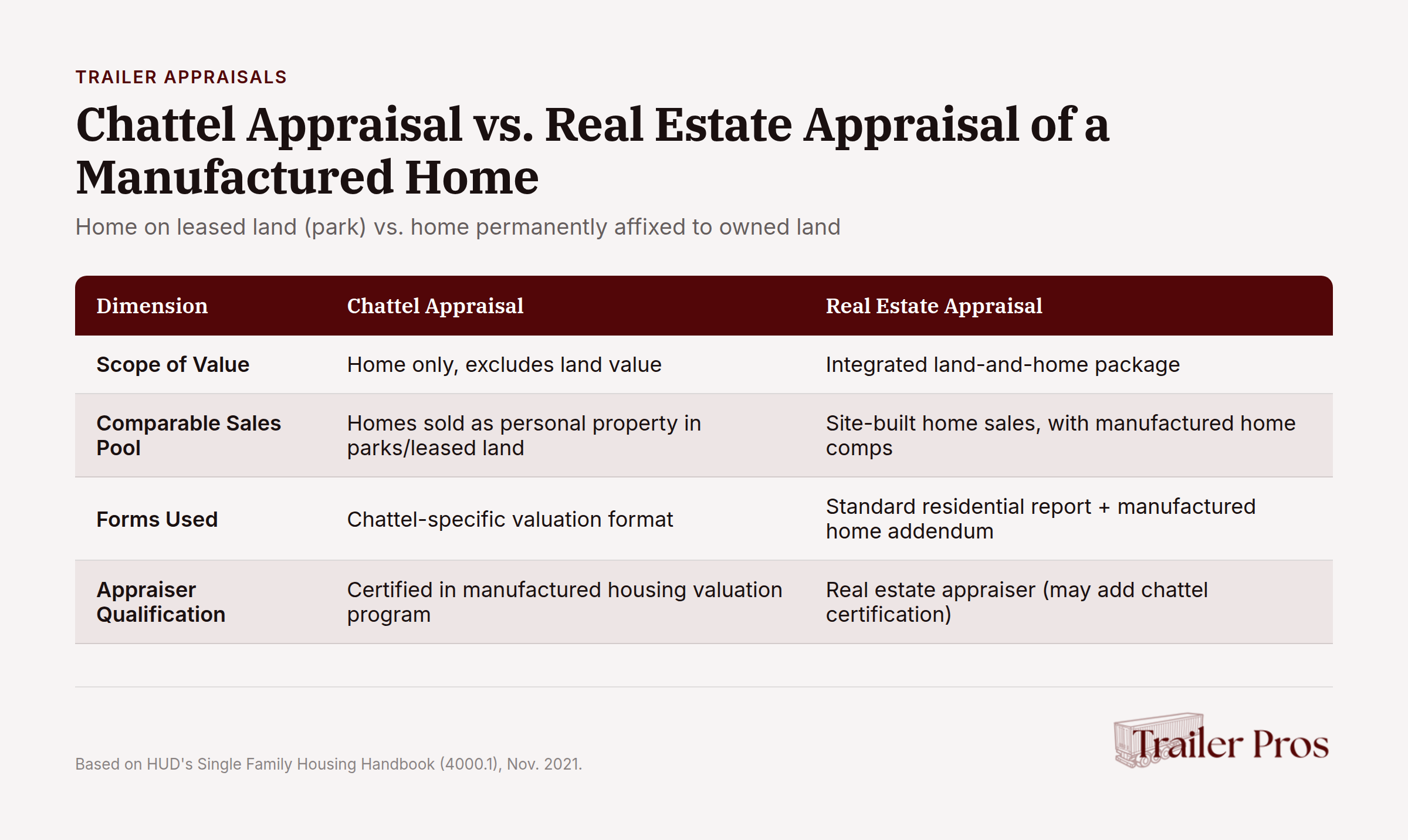
A chattel appraisal and a real estate appraisal of a manufactured home answer two different questions, even when the physical structure looks identical. The chattel appraisal values the home by itself, drawing on comparable sales of other homes sold as personal property in parks or on leased land, and it excludes any land value entirely. A real estate appraisal of a manufactured home permanently affixed to owned land instead values an integrated land-and-home package, using the standard residential appraisal report format built for site-built homes, with a manufactured home addendum.
The appraiser's qualifications differ too. Federal guidance defines a chattel appraiser as someone certified under a manufactured housing valuation program, trained specifically to value homes as personal property, or a real estate appraiser who separately certifies competence in chattel valuation, according to HUD's Single Family Housing Handbook. That certification exists precisely because a chattel appraisal draws from a different comparable sales pool and a different scope of work than a land-based residential appraisal.
What Drives the Value of a Trailer Park Home?
Because the land is never part of the collateral, value drivers in a chattel appraisal are almost entirely about the home itself and the market it sits in. The main factors an appraiser documents include:
- Age and physical condition: roof, siding, windows, flooring, and mechanical systems all factor into how much the home has depreciated since it was manufactured.
- Make, model, and configuration: single-wide versus double-wide or multi-section construction, square footage, and layout all affect comparable sales selection.
- HUD compliance and data plate: homes built after June 15, 1976 carry a HUD certification label confirming they meet federal manufactured housing construction standards; homes without it face a smaller pool of comparable sales and financing options.
- Title status: whether the home is cleanly titled as chattel, free of liens, and properly registered affects both marketability and financing eligibility.
- Lot rent and park quality: even though park land is never appraised, identical homes in a well-run, stable community with reasonable lot rent typically command stronger comparable sales than the same home in a distressed or poorly managed park, a pattern documented in industry analysis of why manufactured homes appraise differently depending on where they sit.
Watch out: a home missing its HUD data plate, or one built before the 1976 federal standards took effect, can be significantly harder to finance and may appraise lower simply because fewer comparable chattel sales and loan programs exist for it.
When Do Trailer Park Residents Actually Need One?
Most residents encounter the need for a chattel appraisal at one of five specific moments, all tied to the same underlying fact: the home is a distinct, appraisable asset separate from the land.
- Financing or refinancing a chattel loan. Lenders and FHA Title I programs generally require an independent appraisal before funding a loan secured only by the home.
- Setting or disputing insurance coverage. An appraised value helps align policy limits with the home's real market worth rather than a generic estimate.
- Park sale, closure, or relocation. When a park is sold or redeveloped, negotiations over resident buyouts or relocation compensation often rely on a documented value for each home.
- Estate settlement. Executors need a fair market value to divide the asset among heirs or report it as part of the decedent's personal property.
- Divorce and equitable distribution. Courts typically want independent appraisal evidence before assigning a value to the home in a marital estate.
Getting a USPAP-Compliant Trailer Park Chattel Appraisal
A chattel appraisal only holds up in a loan file, an insurance dispute, a probate filing, or a courtroom if it is prepared by a qualified personal property appraiser working in accordance with USPAP. That means a documented inspection, a defined scope of work, and a comparable sales analysis built specifically around chattel-titled homes rather than land-based comparables.
At TrailerAppraisals.com, trailer appraisals are quoted as a fixed fee before work begins, never billed hourly, with pricing set by the scope of the assignment rather than the home's value. Fees for standard trailer appraisals generally start at $195, with IRS-qualified reports starting at $295, and typical assignments running $195 to $495 depending on complexity and intended use. Request an appraisal to get a scoped, fixed-fee quote for your trailer park home, whether you need it for financing, insurance, an estate, or a divorce settlement.
This article is provided for general informational purposes only and does not constitute legal, tax, or financial advice. Readers should consult a qualified attorney or CPA regarding their specific circumstances.