
Blog
How Trailers Are Classified for Personal Property Tax: RV, Travel Trailer, or Something Else
Trailer personal property tax classification depends on statutory definitions and title status, not on what the owner calls the unit. Kansas serves as the worked example, showing why an RV title and a market-value listing produce different tax bills.
Published
Key Takeaways on Trailer Personal Property Tax Classification
Here is what trailer owners need to know about how assessors classify a trailer for personal property tax:
- Statutory definition controls: A state assessor classifies a trailer by the legal definition of an RV, travel trailer, or other property, not by the label the owner uses. A unit sold as a "camper" can still land in a different category than the owner expects.
- Title status matters: In Kansas, a unit that meets the statutory requirements for an RV title is taxed through the RV title and registration system. A unit without an RV title is listed as personal property instead.
- The valuation method changes with the class: Kansas values RV-titled units by an age-and-weight formula. Kansas values non-titled travel and camping trailers at market value as of January 1.
- Other states differ: Each state and county sets its own definitions and procedures, so the state or county assessor is the authority for any specific trailer. A travel trailer appraisal supports market value but does not change the classification.
Trailer personal property tax classification decides which valuation method an assessor applies to a towable unit, and that method drives the bill. An owner who assumes a travel trailer is automatically taxed as an RV can be surprised by a different listing, a different valuation basis, and a different tax amount. This guide uses Kansas as a worked example, explains why misclassification changes the result, and shows where a USPAP-compliant appraisal fits.
How Assessors Decide Trailer Personal Property Tax Classification
Assessors decide trailer personal property tax classification by applying the state's statutory definitions to the unit's design, use, and title status. The owner's description, the dealer's brochure, and the way the trailer is advertised carry no legal weight in that decision.
Three questions usually sort a trailer into a category:
- Design: Whether the unit is built on or for use on a chassis and designed primarily as living quarters for recreational, camping, vacation, or travel use.
- Mobility: Whether the unit has its own motive power or is mounted on or drawn by another vehicle.
- Title and registration: Whether the unit holds the title or registration type that the state's tax system ties to RV treatment.
A towable utility, cargo, equipment, boat, or horse trailer fails the living-quarters test and falls outside RV treatment. A travel trailer passes the design test, but the title question still decides how the tax is calculated. Owners who want the vehicle-type distinctions behind these labels can read the guide on RV vs trailer ownership.
Kansas Example: When a Trailer Is Taxed as an RV
Kansas taxes a unit as an RV when the unit meets the statutory requirements for an RV title. According to the Kansas Department of Revenue Personal Property Valuation Guide, those units include motor homes, campers, and travel trailers that qualify for the RV title.
Kansas values a qualifying RV for property tax through the RV title and registration system. The valuation uses an age-and-weight formula rather than an individual market appraisal. The county does not look at the particular unit's condition, upgrades, or local resale market to set the taxable value.
Example: Two owners each hold a 2015 travel trailer of similar length. The owner whose unit carries an RV title pays tax from the age-and-weight formula. The unit's interior condition and installed features do not enter that calculation.
The formula approach is predictable, which is its main advantage. A well-maintained unit and a neglected unit of the same age and weight produce the same taxable value.
Kansas Trailer Personal Property Tax Classification Without an RV Title
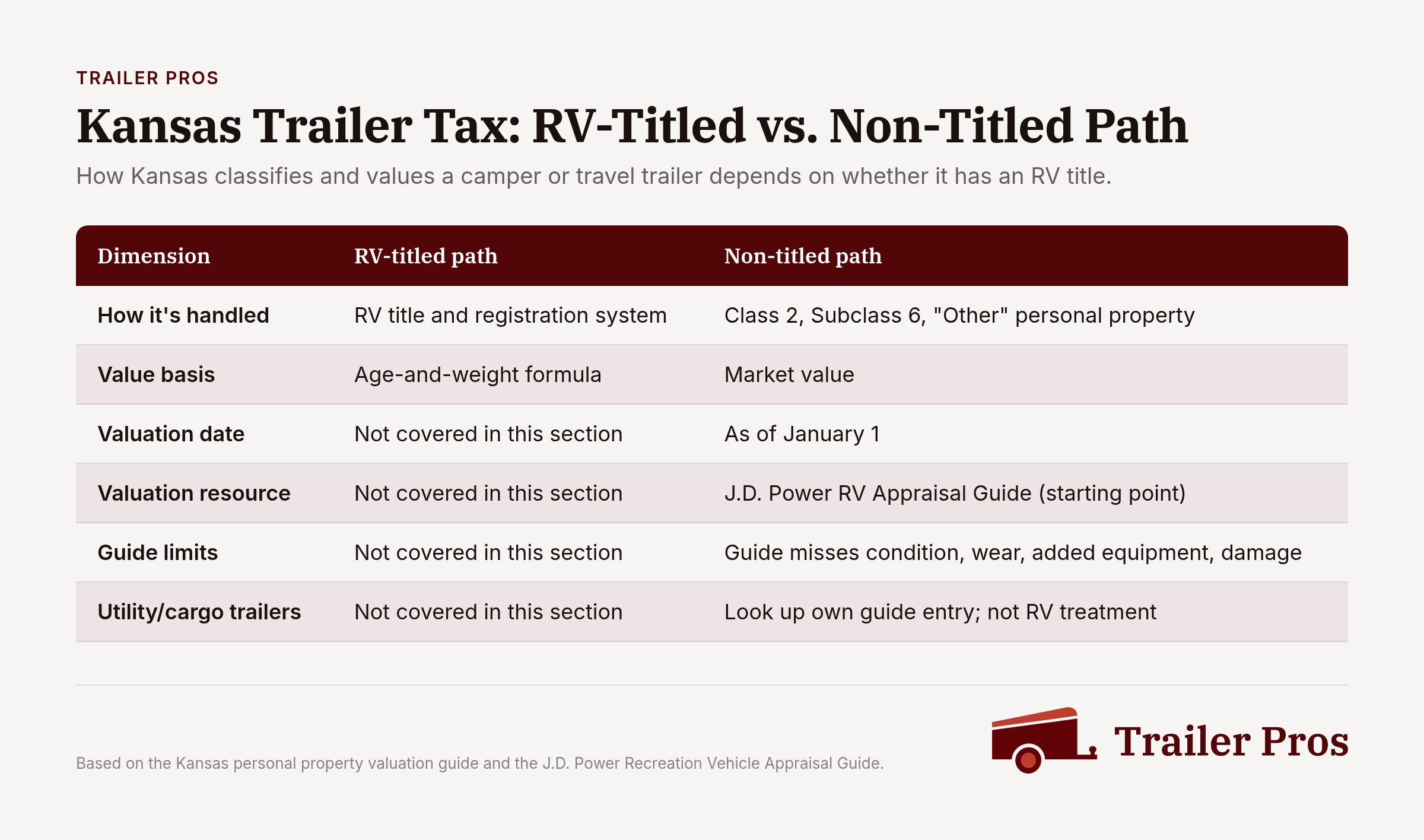
Kansas lists a truck camper or a travel or camping trailer without an RV title in Class 2, Subclass 6, "Other" personal property. The same Kansas guide values that property at market value as of January 1.
For recreational units, Kansas guidance references the J.D. Power Recreation Vehicle Appraisal Guide as a valuation resource. A guide value is a starting point for a typical unit. Condition, mileage-equivalent wear, added equipment, and damage are not captured in a generic guide figure.
The Kansas guide treats motor homes, travel trailers, and fifth-wheel travel trailers as a separate group from truck campers and ordinary utility or cargo trailers. Utility and cargo trailers are addressed under their own entries in the guide, so owners of those units look up the specific trailer type instead of assuming RV treatment.
Why Trailer Personal Property Tax Classification Changes the Tax Bill
Trailer personal property tax classification changes the tax bill because each class uses a different valuation method. A formula-based class produces a value from age and weight. A market-value class produces a value from what the unit would sell for on January 1.
The table below compares the two Kansas paths described in the Kansas guide:
| Factor | RV-titled unit | Unit without an RV title |
|---|---|---|
| Typical units | Motor homes, campers, travel trailers meeting RV title requirements | Truck campers, travel and camping trailers without an RV title |
| Where it is taxed | RV title and registration system | Listed as personal property, Class 2, Subclass 6 "Other" |
| Valuation basis | Age-and-weight formula | Market value as of January 1 |
| Condition and features | Not part of the formula | Relevant to market value |
The direction of the difference varies by unit. A heavily upgraded, low-wear trailer can carry a higher market value than a formula would assign. A trailer with water damage or structural problems can carry a much lower market value than the formula figure.
Watch out: An owner who assumes the wrong path can compare a neighbor's bill to their own and draw the wrong conclusion. Two similar trailers taxed under different methods will not produce matching numbers.
How to Check Your Trailer's Classification
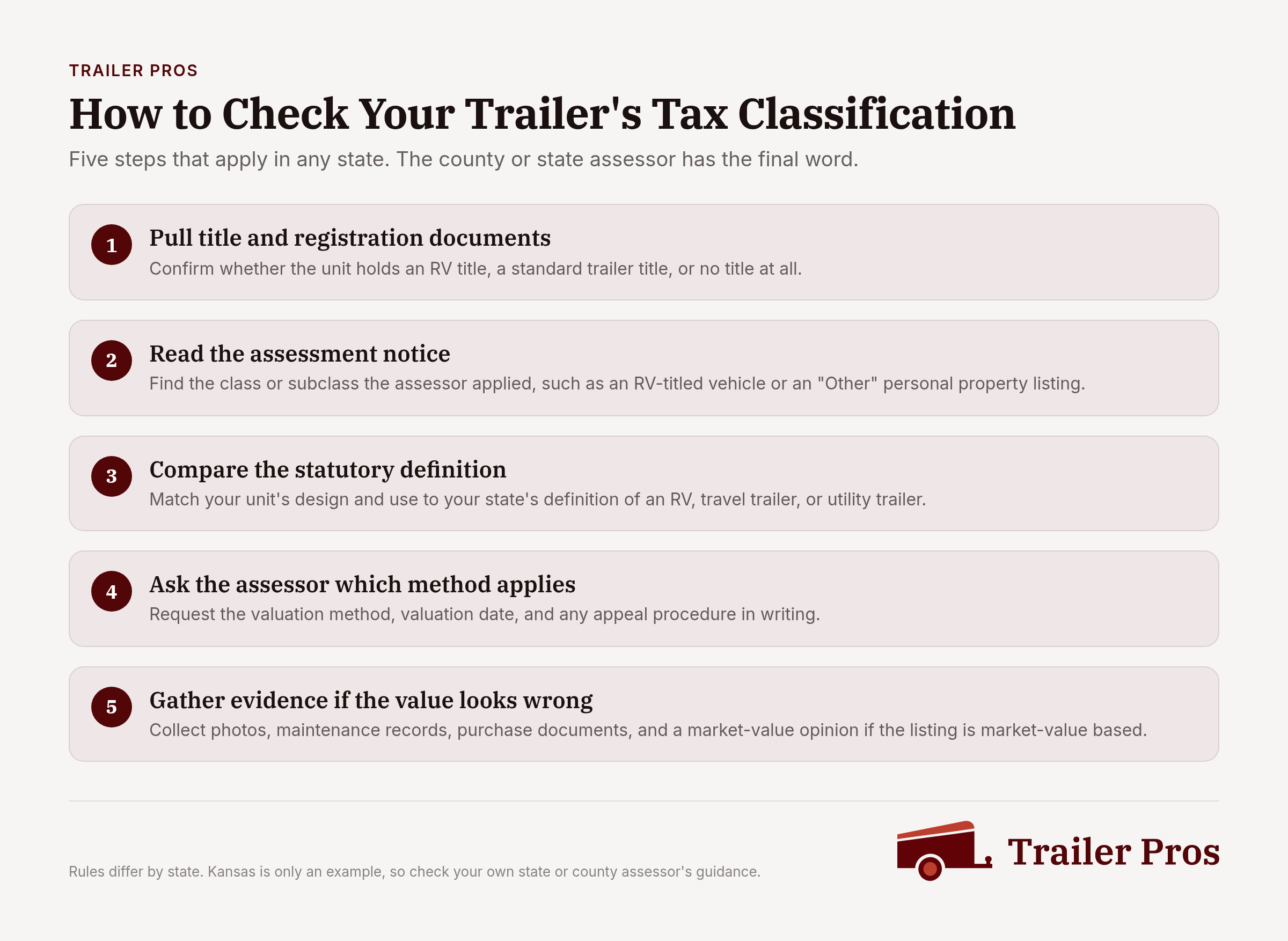
Checking a trailer's classification takes a short sequence of steps, and the county or state assessor has the final word. The process below applies in any state:
- Pull the Title and Registration Documents
- Confirm whether the unit holds an RV title, a standard trailer title, or no title at all.
- Read the Assessment Notice for the Class or Category
- The notice names the class or subclass the assessor applied, such as an RV-titled vehicle or an "Other" personal property listing.
- Compare the Statutory Definition to Your Unit
- Match the unit's design and use against the definition of an RV, travel trailer, or utility trailer in your state's guidance.
- Ask the County or State Assessor Which Method Applies
- Request the valuation method, the valuation date, and any appeal procedure in writing.
- Gather Evidence if the Value Looks Wrong
- Collect photos, maintenance records, purchase documents, and a market-value opinion when the listing is market-value based.
Other states define and tax trailers differently from Kansas. A travel trailer that follows one path in Kansas can follow a different path elsewhere, so owners in any other state need to read their own state or county assessor's guidance instead of relying on the Kansas example.
When a Trailer Appraisal Supports a Personal Property Tax Dispute
A USPAP-compliant trailer appraisal supports a dispute when the trailer is valued at market value and the owner believes the assessed figure is too high. The appraisal documents the unit's condition, features, and market value as of the relevant date. It supports the owner's position on value.
An appraisal does not change the classification. The assessor and the state's statutes decide whether a trailer is an RV, a travel trailer, or "Other" personal property. Trailer Pros appraisals address the value question only, and a formula-based RV title valuation leaves little room for a market-value argument.
Owners find an appraisal most useful in situations like these:
- Market-value listings: The unit sits in a non-RV class where the assessor values it at market value as of a stated date.
- Condition problems: Damage, deferred maintenance, or structural issues lower the unit's market value below a generic guide figure.
- Unusual features: Custom builds, conversions, or heavy upgrades make a standard guide value unreliable.
- Records for an appeal: The owner needs a defensible, written valuation to attach to a formal appeal.
Our appraisers prepare reports in accordance with USPAP, which The Appraisal Foundation publishes, and credentials among our team include organizations such as the ASA, ISA, and CAGA. Trailer Pros quotes each engagement as a fixed fee before work begins, and the fee reflects the scope of the assignment, such as the type of trailer and the number of units.
Confirm Your Trailer Personal Property Tax Classification Before the Bill Arrives
Trailer personal property tax classification starts with the statutory definition and the title, and the valuation method follows from there. In Kansas, a qualifying RV title leads to an age-and-weight formula, and a non-titled travel or camping trailer leads to a January 1 market-value listing. Owners in every other state need to verify their own rules with the state or county assessor.
Owners who face a market-value assessment can request a trailer appraisal from Trailer Pros to document condition, features, and value.
This article is provided for general informational purposes only and does not constitute legal, tax, or financial advice. Readers should consult a qualified attorney or CPA regarding their specific circumstances.