
Blog
Types of Trailers: A Guide to Trailer Classifications and Appraisal Value
The types of trailers on the road today range from dry vans to livestock haulers to travel trailers, and each classification changes how an appraiser sources comparables, applies depreciation, and values specialty equipment. This guide breaks down the major categories and explains why matching the right credentialed appraiser to the right trailer type protects your insurance, financing, estate, or donation valuation.
Trailers get lumped together in casual conversation, but a dry van, a lowboy, and a travel trailer have almost nothing in common once you look past the wheels and the hitch. They're built differently, they wear differently, they sell in different markets, and they require different appraisal methodology. If you're insuring a trailer, financing one, donating one, or settling an estate that includes one, understanding its classification is the first step toward getting a defensible value.
This guide walks through the major trailer categories, what each one is built to do, and how classification shapes the appraisal approach an appraiser has to take.
How Are Trailers Classified?
Trailer classification is functional, not statutory. There is no single federal taxonomy that names "dry van" or "lowboy" as an official category. Instead, the industry has settled on operational categories based on deck configuration, enclosure type, and cargo purpose, and these categories are what dealers, carriers, and appraisers use to organize the market.Common trailer classifications reflect this operational logic rather than a regulatory one.
What federal rules do regulate directly is weight, not trailer type. The Federal Motor Carrier Safety Administration ties commercial driver's license requirements to a gross vehicle weight rating or gross combination weight rating of 26,001 lb, a threshold that applies to the tractor-trailer combination rather than to any single named trailer category. That distinction matters for appraisal: two trailers that look nearly identical from the outside can fall into very different regulatory and market tiers depending on their GVWR and axle count.
Watch out: Don't assume a trailer's classification based on its shape alone. A step deck and a double drop can look similar in a photo, but their legal height allowances, axle spacing, and resale markets are distinct enough to produce very different appraised values for the same condition and age.
Major Trailer Types and What They're Built to Haul
Dry Van
A dry van is an enclosed box trailer used for general freight that needs to stay dry and protected, and it's the most common trailer type on U.S. highways, typically running 48 ft to 53 ft with legal payloads around 45,000 lb.Dry van specifications are well documented because the type is so widely used. That volume is good news for appraisers: dry vans have the deepest, most liquid resale market of any trailer type, which means abundant comparable sales data and predictable depreciation curves tied mainly to age, floor condition, and whether the unit still meets current 53-ft OEM spec.
Refrigerated Trailer (Reefer)
A reefer is an enclosed trailer with an integrated refrigeration unit, used for temperature-controlled freight like food and pharmaceuticals.Reefer trailer specs show dimensions similar to dry vans, but the refrigeration unit itself is a major, separately depreciating value component. An appraiser has to weigh the box condition and the unit's age, engine hours, and maintenance history independently; an otherwise sound reefer with an outdated or unreliable unit can be functionally obsolete even if the trailer body is in excellent shape.
Flatbed
A flatbed trailer is an open deck with no roof or walls, used for palletized freight, lumber, steel, and machinery that can tolerate weather exposure.Flatbed configurations load easily from the side or top with a forklift or crane. Flatbeds take heavy wear from chains, binders, and repeated loading, so appraisers focus closely on deck integrity (steel versus wood), stake pockets, and frame straightness rather than cosmetic condition alone.
Step Deck / Drop Deck
A step deck has two deck heights, a higher front section and a lower rear section, which lets it carry taller freight while staying within legal highway height limits without an oversize permit.Step deck use cases put this type squarely in the heavy-haul and project cargo market. Because that market is more specialized than general freight, appraisers have fewer comparable sales to draw on and lean more heavily on deck length, axle configuration, and documented use history.
Lowboy / Double Drop / RGN
Lowboys, double drops, and removable gooseneck (RGN) trailers ride low to the ground with a deep center well, built for tall, heavy loads like excavators and bulldozers. Configurations vary widely, with some heavy-haul combinations rated well into the hundreds of thousands of pounds.Heavy-haul trailer capacity depends on axle count, gooseneck type, and permitted operating configuration. This is a niche market, so an appraiser has to benchmark against recent heavy-haul sales specifically, not general flatbed data, and account for the local permitting rules that govern where the trailer can legally operate.
Tank Trailer
A tank trailer is a cylindrical tank body used to transport liquids such as fuel, chemicals, or milk, with common highway configurations carrying over 33,000 lb of liquid.Tank trailer classes are grouped by weight class and regulatory spec. Value here depends on more than capacity; DOT/TC compliance, lining material, and compartment design determine whether the trailer can still be used for its intended commodity, and a non-compliant tank can drop to salvage value fast.
Dump Trailer
Dump trailers, including side-dump configurations, haul aggregate, dirt, and similar bulk materials and are common in construction and agriculture. Their value ties closely to regional industry demand and axle configuration relative to local weight rules, so an appraiser working a dump trailer in a farming region will use different comparables than one in an urban construction market.
Livestock Trailer
A livestock trailer transports cattle, hogs, and other animals with ventilated walls and secure gates, typically ranging from about 9,400 lb to 24,000 lb GVWR and 14 ft to 34 ft in length. Livestock trailer specs matter for appraisal because ventilation, flooring, and corrosion condition affect usability as much as age does. Regional livestock density also shapes resale demand, which an appraiser has to factor into market selection.
Enclosed Cargo / Utility Trailer
A utility trailer is typically an open or lightly enclosed deck with a ramp, used for tools, materials, and small equipment, generally running 1,000 lb to 10,000 lb GVWR and 8 ft to 22 ft long. Utility trailer GVWR ranges put these squarely in local retail and small-business resale markets. Because comparable listings are abundant online, appraisers can usually pull recent local sales quickly, but should still confirm axle rating and whether the trailer has been modified from its original spec.
Gooseneck Trailer
A gooseneck trailer connects to a hitch mounted in the bed of a pickup truck rather than a bumper-pull ball hitch, which gives it more stability and higher capacity for equipment, livestock, or car-hauling use. Appraisers generally see gooseneck configurations command a premium over comparable bumper-pull units in the same category, because the added stability and capacity widen the pool of buyers who can use the trailer for heavier work.
Travel Trailer / RV
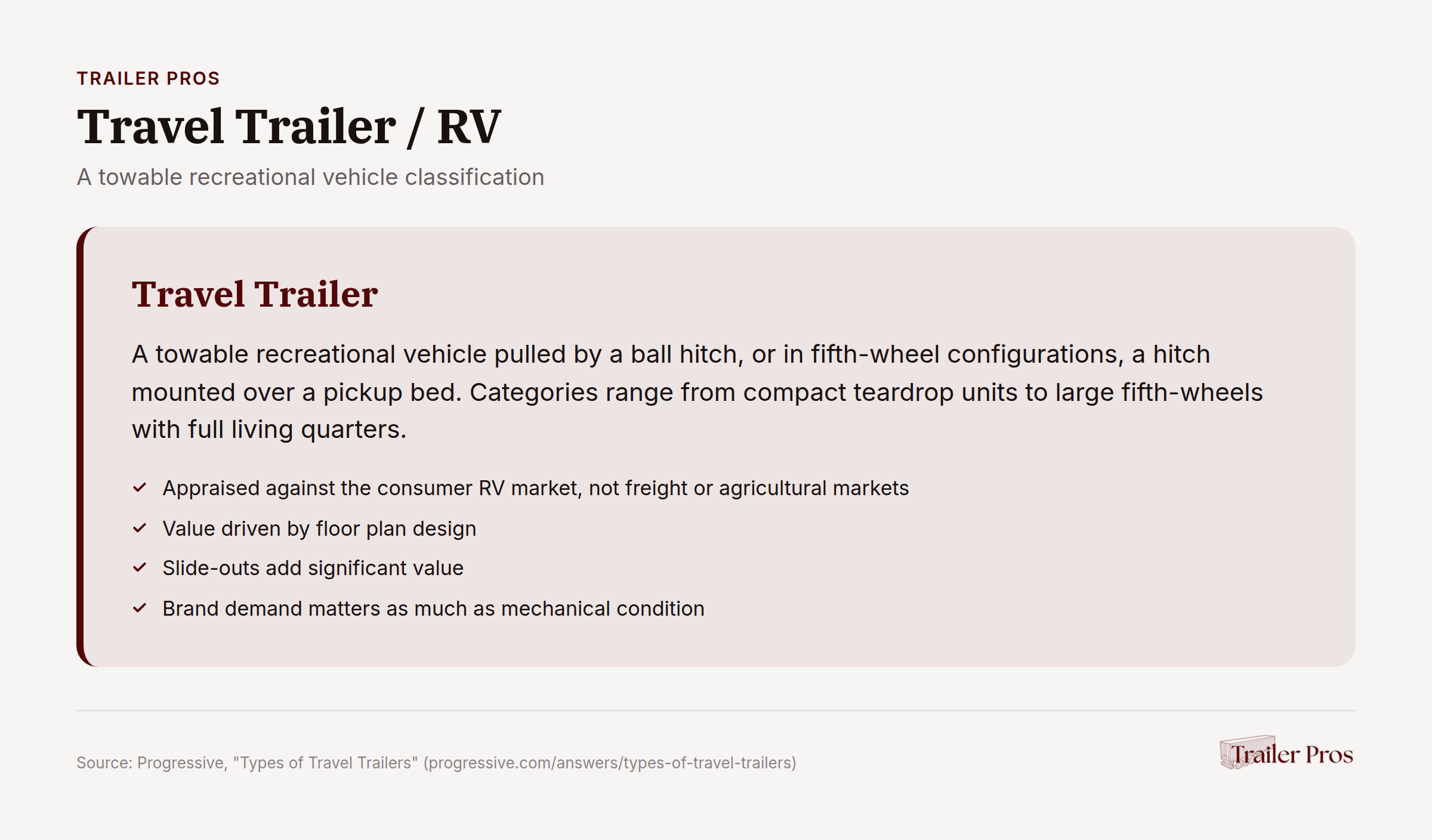
A travel trailer is a towable recreational vehicle pulled by a ball hitch or, in fifth-wheel configurations, a hitch mounted over a pickup bed.Travel trailer categories span everything from compact teardrop units to large fifth-wheels with full living quarters. These trailers are appraised against the consumer RV market rather than freight or agricultural markets, with value driven by floor plan, slide-outs, and brand demand as much as by mechanical condition.
Trailer Types Compared: Use, Weight Range, and Appraisal Notes
The table below summarizes typical use and weight range for the major categories, along with what an appraiser watches for in each one.
Trailer Type | Typical Use | Typical GVWR / Capacity Range | Appraisal Consideration |
|---|---|---|---|
Dry Van | General enclosed freight | ~45,000 lb legal payload, 48-53 ft | Deep comparable market, spec compliance drives value |
Refrigerated (Reefer) | Temperature-controlled freight | Similar to dry van plus reefer unit | Refrigeration unit age/hours valued separately |
Flatbed | Palletized, oversized, weather-tolerant cargo | Varies by axle count and length | Deck material and structural wear are key |
Step Deck / Drop Deck | Tall freight within legal height limits | Heavy-haul range, varies by configuration | Fewer comparables, specialty market pricing |
Lowboy / Double Drop / RGN | Heavy equipment, oversize loads | 40,000 lb to 880,000 lb (permitted combos) | Axle count, gooseneck type, permitting drive value |
Tank Trailer | Liquid and bulk commodity transport | 33,000+ lb liquid capacity | Regulatory compliance (DOT/TC spec) critical |
Dump Trailer | Aggregate, dirt, bulk materials | Varies regionally | Regional demand and axle configuration |
Livestock Trailer | Cattle, hogs, other animals | ~9,400-24,000 lb GVWR, 14-34 ft | Ventilation, flooring, corrosion condition |
Enclosed Cargo / Utility | Tools, materials, small equipment | ~1,000-10,000 lb GVWR, 8-22 ft | Abundant local comparables, confirm axle rating |
Gooseneck | Equipment, livestock, car-hauling | Varies, generally higher capacity than bumper-pull | Premium over comparable bumper-pull units |
Travel Trailer / RV | Recreational and full-time living | Varies widely by floor plan | Consumer RV market, brand and features drive value |
Pro tip: When you request an appraisal, have the trailer's VIN, GVWR plate, and any equipment specifications (refrigeration unit model, tank lining, gooseneck rating) ready. It speeds up research and helps the appraiser select the right comparable market from the start.
Why GVWR and Axle Configuration Drive Both Classification and Value
GVWR and axle configuration matter because they set the legal and functional ceiling on what a trailer can carry, and that ceiling is a primary driver of resale demand within its category. Two dry vans of the same length and age can appraise differently if one carries a higher-rated suspension and axle set that lets it run heavier loads than a standard configuration allows.
The CDL threshold set by federal regulation at 26,001 lb GVWR or gross combination weight rating is a regulatory hook that affects who can legally operate a given trailer combination, which in turn affects the buyer pool an appraiser considers when selecting comparables. A trailer that falls just under that threshold may see broader demand from owner-operators without a commercial license, while one that requires a CDL narrows the buyer pool to commercial fleets and larger operators.
Key takeaway: Classification tells an appraiser what market to look in. GVWR and axle configuration tell the appraiser where within that market the specific trailer sits, and both pieces of information are necessary before a defensible value can be reached.
How Trailer Type Shapes the Appraisal Approach
Every trailer category above changes at least one of three things for the appraiser: market data availability, the depreciation schedule applied, and how specialty equipment gets valued.
Market data availability: High-volume types like dry vans and utility trailers have deep comparable sales data, while heavy-haul lowboys, RGNs, and custom tank trailers require the appraiser to draw on a narrower, more specialized set of recent transactions.
Depreciation schedule: A dry van box depreciates fairly predictably with age and mileage, but a reefer's refrigeration unit, a tank's lining, or a Conestoga's tarp system can depreciate on a completely different curve than the trailer chassis itself.
Specialty equipment valuation: Refrigeration units, hydraulic dump mechanisms, gooseneck hardware, and livestock ventilation systems all need to be valued as distinct components, not folded into a single lump figure for the trailer as a whole.
This is also why one appraisal template doesn't work across every category. A semi trailer appraisal built around dry van or flatbed comparables uses a different research process than a livestock trailer or a travel trailer appraisal, even though the underlying methodology, following recognized appraisal standards, stays consistent.
Why Trailer Type Should Determine Who Appraises It
The direct answer: a credentialed appraiser familiar with your trailer's specific category will produce a more defensible value than a generalist, because comparable selection, depreciation modeling, and specialty component valuation all depend on category-specific market knowledge.
Our appraisers hold credentials with organizations such as the American Society of Appraisers and the Certified Appraisers Guild of America, and machinery and equipment appraisers in this field commonly pursue credentials like the Certified Machinery and Equipment Appraiser (CMEA) designation alongside these. Every report we prepare is built in accordance with the Uniform Standards of Professional Appraisal Practice published by The Appraisal Foundation, regardless of whether the trailer in question is a dry van, a livestock hauler, or a fifth-wheel RV.
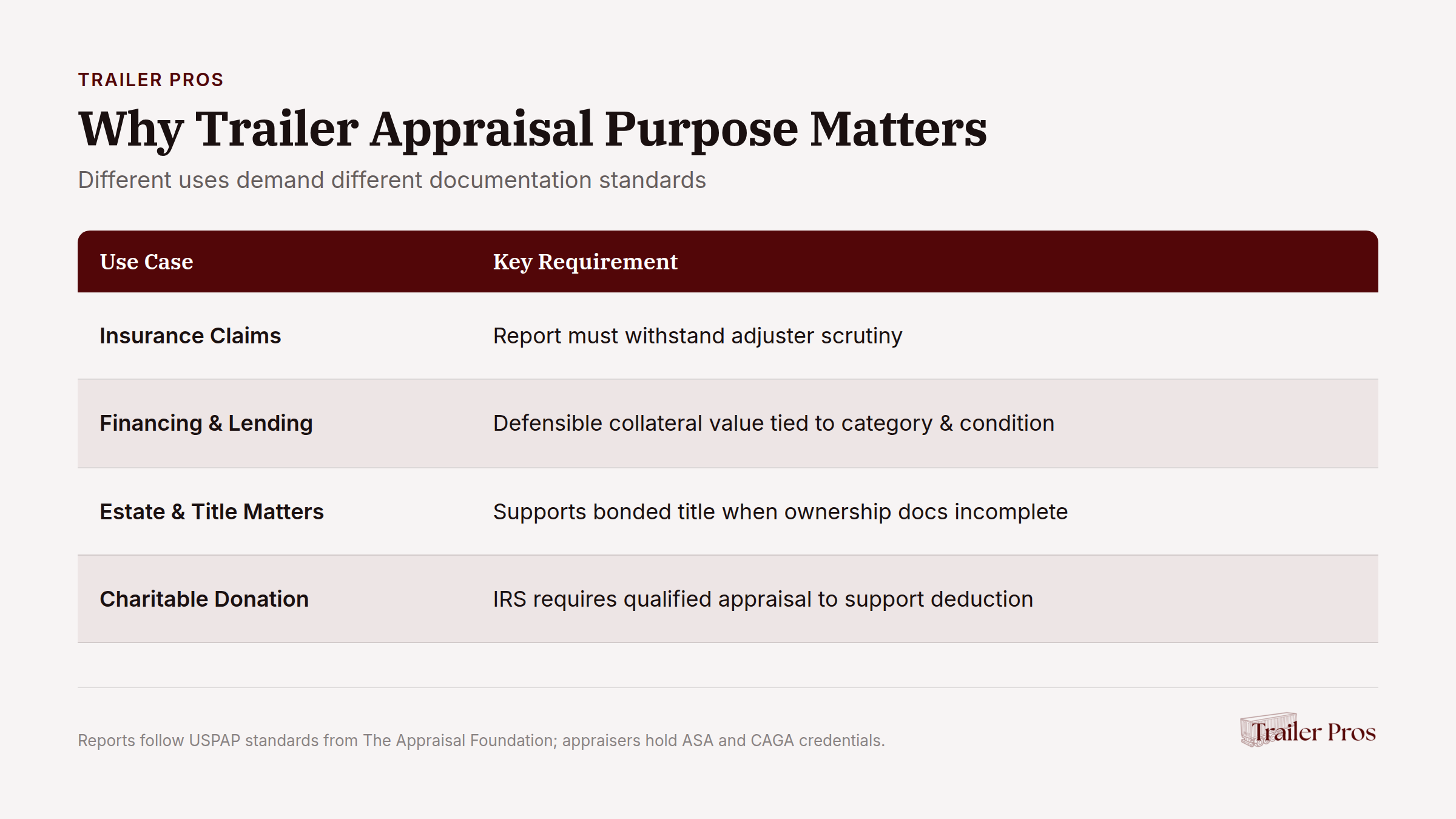
That consistency matters because trailer appraisals get used for very different purposes, each with its own documentation expectations:
Insurance claims on damaged or totaled trailers, where the report needs to withstand adjuster scrutiny; see our trailer appraisal for insurance claims service for how this works.
Financing and lending, where a lender needs a defensible collateral value tied to the trailer's actual category and condition.
Estate and title matters, including trailer appraisal for a bonded title when ownership documentation is incomplete.
Charitable donation reporting, where the IRS requires a qualified appraisal to support the claimed deduction; our trailer appraisal for charitable donation service is built around those requirements.
Getting the Right Value for Your Trailer
The types of trailers on the road span everything from high-volume dry vans to niche heavy-haul lowboys to consumer travel trailers, and each one calls for a different appraisal lens. Classification isn't just a label; it determines the comparables an appraiser pulls, how depreciation gets applied, and how specialty equipment gets valued separately from the trailer itself.
If you need a USPAP-compliant appraisal for insurance, financing, an estate, or a charitable donation, our team appraises the full range of trailer categories covered here. Visit our trailer appraisal services page or request a trailer appraisal to get started with an appraiser who knows your specific trailer type.
This article is provided for general informational purposes only and does not constitute legal, tax, or financial advice. Readers should consult a qualified attorney or CPA regarding their specific circumstances.